-
Now live! Generate even more savings with our Skygate system. Click here to learn more.

On this page
- What Are Bifacial Solar Panels?
- How Much Extra Energy Do Bifacial Panels Actually Generate?
- Where Bifacial Panels Perform Best in the UK
- Where Bifacial Panels Are Not the Right Choice
- How to Decide Whether Bifacial Panels Are Worth It for Your Installation
- How Upvolt Assesses Whether Bifacial Panels Are Right for Your Site
- Let's Recap
- About Upvolt
- FAQ
Solar Photovoltaic
15 mins read
Bifacial Solar Panels: When Do They Make Sense?
25 Jul 2026How bifacial solar panels generate extra energy and when they're a good fit for UK homes.
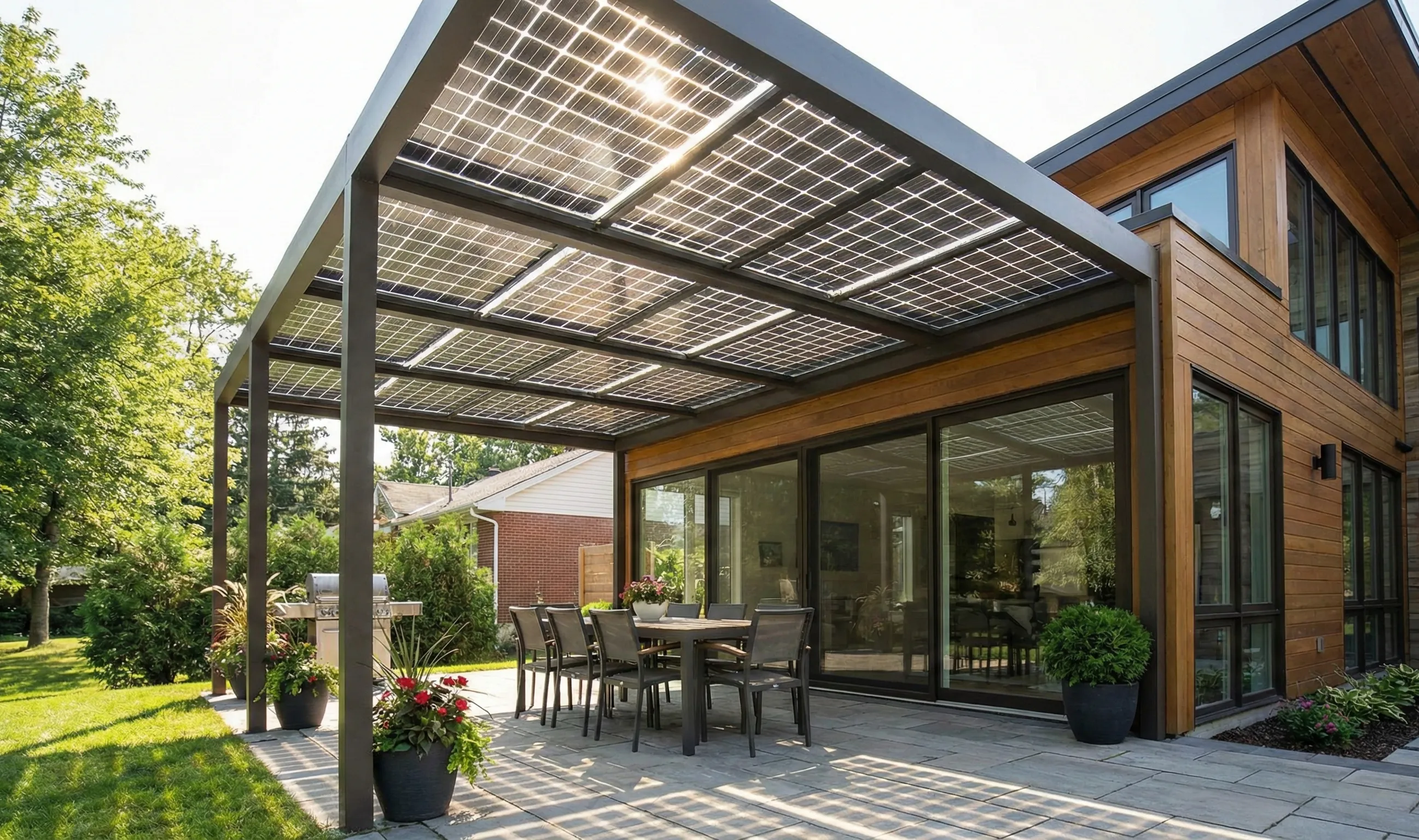
Take the first step toward energy independence today.
get a quote
On this page
- What Are Bifacial Solar Panels?
- How Much Extra Energy Do Bifacial Panels Actually Generate?
- Where Bifacial Panels Perform Best in the UK
- Where Bifacial Panels Are Not the Right Choice
- How to Decide Whether Bifacial Panels Are Worth It for Your Installation
- How Upvolt Assesses Whether Bifacial Panels Are Right for Your Site
- Let's Recap
- About Upvolt
- FAQ
Bifacial solar panels offer a genuine performance advantage over standard panels, but that advantage only materialises under a specific set of installation conditions that most UK pitched-roof homes do not meet. The technology is real, the energy yield gains are measurable, and in the right environment the financial case is strong.
The question is whether your roof, ground, or commercial site is that environment. This guide works through the conditions that determine the answer.

15 min read
On this page
- What Are Bifacial Solar Panels?
- How Much Extra Energy Do Bifacial Panels Actually Generate?
- Where Bifacial Panels Perform Best in the UK
- Where Bifacial Panels Are Not the Right Choice
- How to Decide Whether Bifacial Panels Are Worth It for Your Installation
- How Upvolt Assesses Whether Bifacial Panels Are Right for Your Site
- Let’s Recap
- About Upvolt
- FAQ
Key Takeaways
- Bifacial solar panels generate electricity from both front and rear surfaces, but rear-side power generation only delivers meaningful additional yield when panels are elevated above a reflective surface with an albedo coefficient significantly higher than standard roof tile or dark felt.
- On standard UK pitched roofs with close-mounted panels, rear-side irradiance is near zero, meaning a comparable high-efficiency monofacial panel typically delivers equal or better return on investment at lower cost.
- Ground-mounted systems and flat commercial roofs with tilted racking and white TPO or PVC membrane are the environments where bifacial panels produce enough extra energy yield to justify their premium, which industry pricing data suggests runs approximately 10 to 15% above comparable monofacial panels.
- Adding an EV charger or heat pump to a property increases self-consumption of any additional generation from bifacial rear-side gain, which strengthens the financial case for bifacial specification in homes planning full electrification.
What Are Bifacial Solar Panels?
Bifacial solar panels generate electricity from both their front and rear surfaces, unlike standard monofacial solar panels, which only convert light striking the front face. This dual-surface capability is made possible by replacing the opaque polymer backsheet used in conventional panels with a transparent backsheet or, more commonly in bifacial construction, a second pane of glass.
At a Glance: A bifacial solar panel captures direct sunlight on its front surface and reflected light from below on its rear surface. The amount of additional energy that rear surface generates depends entirely on how much light reaches it, which is a function of mounting height, surface type, and installation geometry.
The rear surface of a bifacial panel is characterised by its bifaciality factor, typically ranging from 65 to 80%. This figure describes how much of the front-surface efficiency the rear can achieve under identical irradiance.
A panel with a bifaciality factor of 70% can generate approximately 70% of what the front produces when exposed to the same light intensity. This does not mean total output is 70% higher. It sets the ceiling for rear-side contribution, and reaching anywhere near that ceiling requires a highly reflective surface beneath the panel.
How Dual-Glass Construction Differs from a Standard Framed Panel
Rear-face construction is the practical dividing line between bifacial and monofacial panels. That single design choice, glass or polymer on the back, cascades through weight, mounting, and long-term durability in ways that matter both at installation and across the panel’s operational life.
Bifacial panels are heavier than standard framed panels because glass replaces the polymer backsheet on the rear face. This affects the racking and mounting systems required and, on older or lightly constructed roofs, creates structural load considerations. The upside is durability: glass resists moisture ingress more effectively than polymer backsheets, contributing to lower long-term degradation rates and longer operational lifespans.
| Feature | Dual-Glass Bifacial | Standard Framed Monofacial |
| Rear-face material | Glass | Polymer backsheet |
| Typical weight per panel | ~22–28 kg | ~18–22 kg |
| Moisture resistance | High | Moderate |
| Annual degradation rate | ~0.3–0.4% | ~0.5–0.7% |
| Structural load impact | Higher | Standard |
| Typical operational lifespan | 30+ years | 25–30 years |
Figures are indicative and vary by manufacturer and product line. Specific panel data sheets should be reviewed at specification stage.
What the Bifaciality Factor Means in Practice
In practice, the bifaciality factor on a spec sheet tells you very little about what your own roof or site will actually deliver. What matters most is the surface beneath your panels, not the number on the datasheet. A panel rated at 80% bifaciality installed above a dark felt flat roof will produce a fraction of the rear-side output the same panel achieves above white gravel, because its ceiling for extra generation is only ever as good as the light reflecting back up to it.
The manufacturer’s front-surface efficiency rating is measured under standard test conditions in a lab, and that figure stays accurate wherever you install the panel. What it can’t tell you is how much of the promised rear-side gain you’ll actually see on your own property, because that comes down to your specific surface and mounting height, not the panel itself.
How Much Extra Energy Do Bifacial Panels Actually Generate?
Real-world energy yield gain from bifacial panels ranges from around 1 to 2% in low-albedo conditions typical of UK pitched roofs to 20 to 30% in optimised ground-mount or flat-roof configurations with highly reflective surfaces beneath the panels. The difference between those figures is not a matter of panel quality. It is a matter of what sits underneath.
Why Ground Reflectance (Albedo) Is the Critical Variable
Albedo, the proportion of incident light a surface reflects rather than absorbs, is a key measure in Earth surface science. Snow reflects 80 to 90% of light. White TPO or PVC membrane reflects around 70 to 80%. Light gravel reflects roughly 30 to 40%. Standard roof tiles sit around 10 to 20%, dark felt around 5 to 10%, and tarmac as low as 4%.
For most UK rooftop installations, the surface directly beneath close-mounted panels is tile or felt, which means effective rear-side irradiance is very low regardless of the panel’s bifaciality factor.
The table below shows approximate albedo ranges for common UK installation surfaces and the corresponding rear-side gain typically achievable under elevated mounting:
| Surface Type | Approximate Albedo | Indicative Rear-Side Gain |
| White TPO/PVC membrane | 70 to 80% | 15 to 25% |
| Light gravel ballast | 30 to 40% | 8 to 15% |
| Pale concrete | 25 to 35% | 6 to 12% |
| Grass | 15 to 25% | 3 to 7% |
| Standard roof tile | 10 to 20% | 1 to 4% |
| Dark felt flat roof | 5 to 10% | 1 to 2% |
These ranges assume adequate elevated mounting height and are illustrative. Actual gain varies with tilt angle, row spacing, and diffuse sky irradiance at the installation site.
What the Research Actually Shows
Peer-reviewed modelling published in Scientific Reports confirms rear-side gains of up to 20 to 30% under optimised bifacial configurations. “Optimised” in that context means elevated mounting above high-albedo surfaces with adequate row spacing and appropriate tilt angles. It does not describe a standard UK residential pitched-roof installation.
In contrast, findings from a published solar modelling study indicate gains of approximately 1 to 2% in low-albedo conditions. The honest picture sits between those two figures, and your installation environment determines where on that range you land.
Where Bifacial Panels Perform Best in the UK
Three installation environments in the UK consistently deliver the conditions bifacial panels require: ground-mounted systems with elevated racking, flat roofs with tilted ballast frames and reflective membrane, and large open-site commercial arrays. In each case, the common factor is elevation above a surface that reflects meaningful light to the rear face.
Ground-Mounted Systems with Elevated Racking
Ground-mounted solar panels represent the ideal bifacial environment. Full 360-degree light access, adjustable tilt angle, and the ability to specify or install the surface beneath the array all work in favour of rear-side generation.
Row spacing in ground-mount bifacial arrays is typically wider than for monofacial installations, reducing the risk of adjacent rows casting shade on rear surfaces. UK domestic ground mounts are less common but appear regularly on larger rural properties where roof area or orientation is a limiting factor.
Flat Roofs with Tilted Ballast Mounting and Reflective Membrane
Flat commercial solar panels installations on ballasted tilt frames above white TPO or PVC membrane represent the most commercially relevant bifacial scenario in the UK. Many commercial flat roofs already use white membrane for thermal performance reasons, which means the high-albedo surface is already present.
Tilted racking elevates the panel rear face above that reflective membrane, creating the geometry bifacial panels need. This combination reliably delivers rear-side gains in the 15 to 25% range under UK irradiance conditions.
Large-Scale Open Sites
At utility-scale solar installations, bifacial panels combined with trackers and fixed-tilt systems on high-albedo ground surfaces can sustain rear-side gain throughout the day as the sun’s angle changes. The levelised cost of energy (LCOE) improvement from bifacial specification at this scale is well-documented.
Most Upvolt readers are not operating at utility scale, but the principle is the same: the larger the reflective surface and the more consistently the panel rear faces it, the more rear-side generation contributes to total output.
Where Bifacial Panels Are Not the Right Choice
For the majority of UK residential solar panel installation projects, bifacial panels are unlikely to justify their premium. The conditions that drive rear-side generation are simply absent on standard pitched roofs, and paying for a capability that cannot express itself produces no financial benefit.
Standard Pitched Roofs with Integrated Tile Mounting
Panel-to-tile clearance on a standard pitched roof is typically 20 to 50mm. At that proximity, there is no meaningful pathway for reflected light to reach the rear cell. The albedo effect cannot operate without line-of-sight between a reflective surface and the rear face of the panel, and that geometry does not exist in close-mounted pitched-roof installations.
A buyer paying the bifacial premium in this scenario receives no rear-side gain and would achieve equivalent or better solar cell efficiency returns from a high-efficiency monofacial panel such as a PERC technology variant at lower overall cost.
Shaded or Dark Surfaces Beneath the Panel Array
Dark gravel, tarmac, standard dark felt, and heavily vegetated or shaded ground cover all produce low ground reflectance regardless of elevated mounting height. Shading losses on the rear surface in these environments are not recoverable through panel selection.
If the surface beneath the array cannot be changed to a higher-albedo material, monofacial panels are the financially rational specification. The bifaciality factor of the panel is irrelevant when rear-side irradiance is near zero.
Sites with Structural Constraints on Panel Weight
Dual-glass bifacial panels are heavier than standard framed monofacial panels. On older or lightly constructed roofs, the additional structural load may be a material consideration. A structural survey would need to confirm load capacity before bifacial panels are specified in any installation where the existing structure has not been assessed for the additional weight.
How to Decide Whether Bifacial Panels Are Worth It for Your Installation
The decision follows a logical sequence of four assessments. Working through them in order prevents the mistake of specifying bifacial panels based on their rated capability rather than the conditions your site actually provides.
Mounting Type and Rear-Side Clearance
If your panels will be flush-mounted or close-mounted to a pitched tiled roof, rear-side conditions will not support meaningful bifacial gain. If the system will use elevated tilt frames on a flat roof or ground-mount racking with adjustable height, rear-side conditions are worth assessing further. Elevated mounting height is the first enabling condition, and without it, the remaining assessment is not necessary.
Surface Reflectivity Assessment
Look at the surface that will sit beneath the panels. Light-coloured surfaces with high albedo, such as white membrane, pale concrete, or light gravel, reflect meaningfully more light than dark surfaces. If the surface is dark or shaded, the rear-side contribution will be low. On commercial flat roofs, it is sometimes practical to install white membrane specifically to improve bifacial performance, which is worth costing as part of the overall system assessment.
The Financial Calculation
Industry pricing data suggests bifacial panels cost approximately 10 to 15% more than comparable monofacial panels. That premium needs to recover through additional energy yield. If rear-side conditions are poor, a high-efficiency monofacial panel, including PERC technology variants, will typically deliver equal or better energy yield at lower cost. A system designer can model this comparison before specification, comparing the return on investment for both options given your site’s reflective conditions.
For a broader view of solar panel return on investment across different system configurations, that comparison should always include self-consumption as the primary savings driver rather than export income.
Future Electrification Planning
Households planning to add an EV charger or heat pump will consume more electricity on-site. Higher self-consumption means any additional generation from bifacial rear-side gain converts directly to bill savings rather than export at lower Smart Export Guarantee (SEG) rates.
If your electrification plans indicate significantly higher future demand, the financial case for bifacial improves because every additional unit generated becomes more valuable when consumed on-site. Understanding how much electricity solar panels generate relative to your projected total consumption is the right starting point for this part of the assessment.
Stay Connected with Upvolt
Get the latest updates on energy innovations, smart solutions, and exclusive offers.
How Upvolt Assesses Whether Bifacial Panels Are Right for Your Site
Site geometry, surface reflectivity, structural load capacity, and future electrification plans all feed into a well-grounded bifacial specification. Upvolt’s MCS-certified operating companies assess each of these factors before recommending panel type, rather than defaulting to bifacial panels as a premium product.
Site Geometry and Surface Reflectivity Review
The assessment covers mounting clearance, available tilt angle, and the reflective properties of the surface beneath the proposed array. What we find in practice is that the reflective surface condition is the most frequently overlooked variable in buyer-led bifacial enquiries. Homeowners often focus on panel specifications rather than the environment those panels will operate in. Understanding the albedo effect of a specific site surface is the step that makes the bifacial decision meaningful rather than speculative.
Panel Selection Based on Installation Environment, Not Default Specification
Upvolt’s MCS-certified operating companies install both bifacial and high-efficiency monofacial solar panels. Panel type is matched to site conditions. Where a high-efficiency monofacial panel delivers equivalent or better return at lower cost, that is what is recommended. The financial interest of the installation, not the panel margin, drives the specification.
Integration with Skygate® for Maximum Self-Consumption
Additional generation, whether from bifacial rear-side gain or from a larger monofacial array, only converts to bill savings when consumed on-site. The Skygate® energy management system aligns household loads with generation windows, directing solar output into appliances, EV charging, and battery storage before allowing export. Without that layer of demand management, even a well-specified bifacial system will export a significant proportion of its output at lower SEG rates rather than displacing higher-cost grid electricity.
Let’s Recap
Bifacial panels do generate more electricity than monofacial panels, but only under precise conditions. Elevated mounting above a high-albedo surface isn’t a nice-to-have, it’s a prerequisite. Without it, the bifaciality factor is a number the installation can’t use.
For most UK homeowners on standard pitched roofs, those conditions don’t exist. Panel-to-tile clearance is too small and tile albedo too low to produce worthwhile rear-side irradiance, so a high-efficiency monofacial panel typically delivers the stronger return here.
The decision sequence is simple: check mounting type and clearance first, then assess surface reflectivity beneath the array. Only when both are favourable does the bifacial-versus-monofacial comparison become a genuine decision rather than an obvious one.
As ground-mount and commercial flat-roof installations grow across the UK, bifacial panels will suit more buyers. For now, specification should follow site conditions, not market trend.
About Upvolt
Upvolt is a renewable energy installer whose panel selection process is driven by site-specific assessment rather than product preference. Upvolt’s MCS-certified operating companies install both bifacial and high-efficiency monofacial solar panels across southern England, and system design begins with evaluating the installation environment before any equipment is specified.
For bifacial panel enquiries, that assessment covers mounting geometry, rear-surface reflectivity, structural load capacity, and planned future electrification, including EV charging and heat pump integration. Where site conditions support bifacial specification, Upvolt’s teams design the system around maximising rear-side irradiance. Where conditions do not support it, a high-efficiency monofacial system is recommended instead.
Whichever panel type is installed, Skygate® provides the energy management layer that ensures generation is directed into self-consumption rather than export, maximising the return on whatever system is in place.
Whether your roof or site has what it takes for bifacial panels to earn their premium, or whether a high-efficiency monofacial system is the smarter call, isn’t something you can tell from a spec sheet. Upvolt can assess your mounting height, surface reflectivity, and site geometry, and tell you exactly which way the numbers point before you commit to anything. Get a free, no-obligation quote.
FAQ
Are Bifacial Solar Panels Worth the Extra Cost for a Standard UK Home?
For most standard UK homes with pitched tile roofs and close-mounted panels, bifacial panels are unlikely to recover their premium through additional energy yield. The rear-side gain that justifies bifacial cost depends on elevated mounting and a high-albedo surface beneath the panels, neither of which a standard pitched roof provides. A high-efficiency monofacial panel is typically the stronger financial choice in this configuration.
How Much More Energy Do Bifacial Panels Generate Compared to Standard Panels?
Additional energy yield ranges from around 1 to 2% in low-albedo conditions to 20 to 30% under optimised configurations with elevated mounting and highly reflective surfaces. The real-world figure for your installation depends on the reflective properties of the surface beneath the array and the mounting geometry. Manufacturer efficiency ratings do not predict this figure; site conditions do.
What Type of Surface Works Best Beneath Bifacial Solar Panels?
White TPO or PVC flat-roof membrane, light gravel ballast, and pale concrete all produce meaningfully higher ground reflectance than dark felt, tarmac, or heavily shaded ground. Snow or white gravel surfaces can reflect 70 to 90% of incident light, substantially increasing rear-side irradiance. The albedo effect of the chosen surface is the primary driver of rear-side gain, and in some flat-roof commercial installations it is practical to install reflective membrane specifically to improve bifacial performance.
Do Bifacial Panels Need a Different Mounting System Than Standard Solar Panels?
Bifacial panels require racking and mounting systems that provide sufficient rear-side clearance for reflected light to reach the back surface. Dual-glass construction also makes them heavier than standard framed panels, which can affect structural load requirements. Row spacing on ground-mount and flat-roof bifacial arrays is typically wider than for monofacial installations to prevent rear-surface shading from adjacent rows.
Can I Add Bifacial Panels to an Existing Solar System?
Adding bifacial panels to an existing system involves compatibility considerations around inverter capacity, string configuration, and whether existing racking can support the additional weight. If the existing installation is on a standard pitched roof, adding bifacial panels without addressing mounting clearance and surface reflectivity will not produce the rear-side gain that justifies their cost. A system designer would need to assess the existing installation before recommending any expansion involving bifacial panels.

Alex Lomax
CEO & Co-Founder
Share article


Share article