-
Now live! Generate even more savings with our Skygate system. Click here to learn more.

Renewable Energy Hardware
15 mins read
What Is a Solar Panel Inverter and How Does It Work?
12 Jul 2026A solar panel inverter converts DC electricity into usable AC power for your home. Learn how they work, which type suits you, and how long they last.
Take the first step toward energy independence today.
get a quote
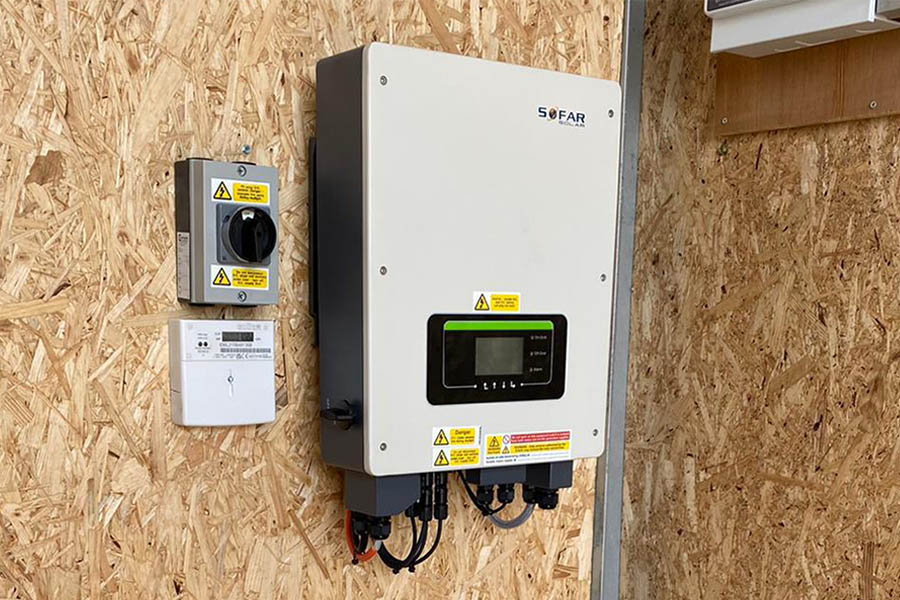
A solar panel inverter is the component that converts the direct current (DC) electricity generated by your panels into the alternating current (AC) electricity that powers your home appliances and the National Grid. Without it, the electricity your panels produce cannot be used by your home or exported to the grid.
Understanding how solar panels work as a complete system starts with understanding what the inverter does and why it sits at the centre of that system.

15 min read
On this page
Key Takeaways
- A solar inverter converts your panels’ raw DC output into the AC electricity your home and the grid can actually use. Without it, your panels generate power you simply can’t access.
- String inverters are the most cost-effective choice for straightforward south-facing roofs, but a single shaded panel drags down output across the whole string, making them a poor fit for complex or partially shaded roofs.
- Hybrid inverters combine solar conversion with battery charge management in one unit, the practical starting point if you’re planning to add battery storage now or later.
- String inverter warranties typically run 5 to 12 years, while panels are warranted for 25 years or more, so most installations will need at least one inverter replacement over the system’s lifetime.
What Does a Solar Panel Inverter Actually Do?
A solar panel inverter converts the direct current (DC) electricity your panels generate into the alternating current (AC) electricity your home appliances and the National Grid actually use. DC flows in a single direction, the same way it does from a battery or a solar cell. AC alternates direction many times per second and is the standard format for mains power in the UK. Since your appliances, your consumer unit, and the National Grid all require AC, the DC output of your panels is unusable without an inverter in the circuit.
The inverter’s five core functions, all running simultaneously whenever your system is generating:
- DC to AC conversion
- Continuous output optimisation through maximum power point tracking (MPPT)
- System performance monitoring
- Grid communication
- Safe shutdown when required
Quick Answer: A solar panel inverter is the device that makes your solar panels usable. It converts DC electricity from your panels into AC electricity your home can use, and continuously adjusts to extract the maximum possible output from your panels at any given moment.
The Role of Maximum Power Point Tracking (MPPT)
Maximum power point tracking (MPPT) is the mechanism by which an inverter continuously adjusts the electrical load on your panels to extract the most power available at any given moment.
- Solar panel output varies constantly with temperature, cloud cover, and sun angle.
- A panel in cool, bright conditions actually produces more power than the same panel on a hot afternoon, even under identical sunlight.
- The inverter scans across the available voltage and current combinations and locks onto the point delivering the highest output, similar to tuning a dial to the clearest signal.
Most quality modern inverters include dual or multiple MPPT inputs, which lets panels on different roof aspects be managed as separate circuits:
- A south-facing string and an east-facing string can each operate at their own optimal point.
- Neither one drags the other down.
The Main Types of Solar Inverter
There are four main inverter types used in UK residential photovoltaic systems: string inverters, microinverters, power optimisers, and hybrid inverters. Each suits a different set of roof and system conditions. No single type is universally superior; the right choice depends on your roof configuration, shading profile, and whether you plan to add battery storage.
String Inverters
A string inverter is a single central unit that manages all panels wired together in a series circuit. Because all panels in the string are linked, the output of the whole string is limited by the weakest-performing panel at any given moment. If one panel is shaded by a chimney, a tree, or even a patch of lichen, every other panel in that string operates at a reduced output to match it.
String inverters are the most widely installed type in UK residential solar and the most cost-effective option for a straightforward south-facing roof with no significant shading. They are well understood by installers, straightforward to maintain, and carry lower upfront costs than panel-level alternatives. They are a poor fit for roofs with multiple aspects, significant shading from surrounding structures, or where panels must face materially different directions.
Microinverters
A microinverter is fitted to each individual panel, converting DC to AC at panel level rather than centrally. Because every panel operates independently, shading or failure on one panel does not reduce the output of the others. This architecture suits roofs with complex shapes, multiple orientations, or partial shading that would otherwise drag down a string inverter system.
The trade-off is cost: microinverters carry a higher price per watt than string inverters. Because there are multiple units mounted on the roof itself, any individual unit failure requires roof access to repair. Microinverters do provide more granular per-panel monitoring data than a central string inverter, which some owners find useful for tracking system performance over time.
Power Optimisers (DC Optimisers)
Power optimisers are not inverters in themselves. They are panel-level devices that condition the DC output of each panel before it reaches a central string inverter. Each panel operates at its own maximum power point, so one panel’s underperformance does not drag down the rest of the string. The central inverter still handles the DC to AC conversion.
This approach sits between a standard string inverter and a full microinverter system. It costs more than a string inverter alone but less than a complete microinverter installation, while delivering many of the shading-tolerance benefits. It is a practical option on roofs with mild to moderate shading where a full microinverter system is difficult to justify on cost.
Hybrid Inverters
A hybrid inverter combines standard solar DC to AC conversion with an integrated battery charge controller, managing both solar generation and battery storage in a single unit. If you’re planning to add battery storage now or in future, a hybrid inverter is almost always the most practical route, retrofitting battery management onto a standard string inverter typically needs additional equipment, adding cost and complexity to what should be straightforward.
Hybrid inverters aren’t all the same, though:
- Some include island mode, letting the system act as a limited backup supply during a grid outage.
- Others don’t.
- Standard grid-tied inverters, including most string inverters, shut down during a power cut due to anti-islanding protection, a safety mechanism required under UK grid connection rules, not a design flaw.
If backup power during outages matters to you, confirming whether a specific inverter model includes island mode is an essential part of the specification process. For more on how battery integration works alongside the inverter, our guide to adding battery storage to a solar system covers the options in detail.
Inverter Type Comparison
| Type | Best For | Shading Sensitivity | Battery Compatibility | Cost Position | Typical Warranty |
| String inverter | Unshaded south-facing roofs | High | Requires upgrade to hybrid | Lower | 5 to 12 years standard |
| Microinverter | Complex or shaded roofs, multiple aspects | Low | AC-coupled battery compatible | Higher | Often 25 years |
| Power optimiser | Moderate shading, single aspect | Low, medium | Requires central hybrid inverter | Mid | Varies by brand |
| Hybrid inverter | Any roof where battery storage is planned | Moderate | Built-in battery management | Mid, higher | 5 to 12 years standard |
Stay Connected with Upvolt
Get the latest updates on energy innovations, smart solutions, and exclusive offers.
How Long Does a Solar Panel Inverter Last?
How long an inverter actually lasts varies a fair bit by type, and it’s worth knowing before you compare systems.
Typical inverter warranty by type:
- String inverters: 5 to 12 years standard, with extended warranties to 20 to 25 years available at extra cost
- Microinverters: often 25 years standard, since panel-level units are designed to match the panels they serve
- Solar panels themselves: typically warranted for 25 years or more
That gap matters. A 10-year inverter warranty against a 25-year panel warranty means a replacement is likely mid-system, and that cost should factor into your total cost of ownership when comparing system options. Our guide to solar panel inverter replacement cost covers what to expect in different scenarios.
Inverter failure is the most common reason a solar system stops generating entirely. The panels keep producing DC electricity, but without a functioning inverter to convert it, none of that power reaches your home or the grid. Most modern inverters display fault codes or send alerts through a manufacturer app when something goes wrong, one reason regular monitoring matters in practice.
Which Type of Inverter Is Right for Your Home?
The right inverter type comes down to three factors: your roof configuration, your battery storage plans, and your budget. None of these can be assessed in isolation, and no single type is the correct answer for every home.
Roof configuration is the first filter:
- A straightforward south-facing roof with no significant shading is where a string inverter performs best, and where the extra cost of microinverters or power optimisers is hard to justify.
- A roof with multiple aspects, panels facing different directions, or shading from trees or structures changes the calculation. Here, a panel-level solution typically recovers enough additional output to offset its higher upfront cost.
Battery storage plans are the second factor. If you intend to add storage at any point, specifying a hybrid inverter from the outset is almost always more cost-effective than converting a string inverter system later.
Budget is the final factor, though it’s worth knowing this: a well-designed string inverter system on an unshaded roof will consistently outperform a poorly specified microinverter system. System design quality matters as much as inverter type choice.
What About Monitoring and System Performance?
Modern solar inverters provide performance data through a manufacturer app or web portal, typically showing:
- Generation figures in kilowatt-hours (kWh)
- Export volumes
- Any active fault codes
Most inverters display a visible fault indicator when something goes wrong, but some faults reduce output gradually rather than triggering an obvious alert. Tracking your system’s daily generation is the most reliable way to catch a developing problem early.
Connecting that inverter data to a broader home energy management system (HEMS) allows smarter decisions about when to use, store, or export electricity. Upvolt’s Skygate® home energy management system integrates solar, battery, EV charging, and heat pump data into one platform, so the system responds to real-time generation and household demand rather than each component operating in isolation.
For guidance on spotting a developing problem, our article on whether your solar inverter is developing a fault covers the common warning signs in detail.
How Upvolt Specifies and Installs Solar Inverters
Inverter selection is one of the most consequential decisions in a solar system design. A mismatched inverter limits system performance from day one and can complicate battery integration or expansion years later. Upvolt treats inverter specification as a system-level engineering decision rather than a default product choice.
Site Assessment and Inverter Specification
Before recommending an inverter type, Upvolt assesses each property’s roof orientation, pitch, shading profile across different times of year, the number of panel strings required, and whether battery storage is planned. What we find in practice is that shading analysis often changes the inverter recommendation significantly.
A roof that appears unobstructed at ground level may experience meaningful partial shading from a neighbouring building during winter months, and a string inverter on that roof will underperform relative to a panel-level solution.
This assessment determines whether a string inverter, hybrid inverter, or a power optimiser configuration is the right fit for the specific installation. It also determines the MPPT configuration, which affects how panels on different aspects are grouped and managed.
Installation and Commissioning
Inverter installation involves positioning the unit in an accessible, well-ventilated location, completing the electrical connections between the panel strings and the consumer unit, and notifying the Distribution Network Operator (DNO) of the new grid-connected system. DNO notification is a regulatory requirement for grid-tied inverter installations, not an optional administrative step.
Commissioning checks confirm that the inverter is generating correctly, that monitoring data is visible, and that all protection settings are calibrated to grid requirements. The Smart Export Guarantee guidance from Ofgem sets out the eligibility conditions that a correctly commissioned inverter must meet for SEG tariff access.
Ongoing Monitoring and Support
After installation, customers have access to inverter performance data through their manufacturer monitoring platform. Upvolt’s Skygate® system provides an additional layer of integrated monitoring, combining solar generation data with battery state, EV charging demand, and household consumption into a single dashboard. If a fault code appears or generation drops unexpectedly, Upvolt’s support team can assess the monitoring data remotely before arranging a site visit.
Let’s Recap
A solar panel inverter is what makes a photovoltaic system usable. It converts your panels’ raw output into electricity your appliances and the grid can accept, while continuously optimising output through MPPT and managing the interface between your generation and the grid. Without it, your panels generate power that simply can’t be accessed.
The choice between inverter types comes down to your roof. String inverters remain right for unshaded, single-aspect roofs, lower cost, simpler design. Microinverters and power optimisers earn their higher cost where shading or orientation complexity is genuinely present. Hybrid inverters are the logical choice for any home where battery storage is part of the plan, building that capability in from the start beats retrofitting it later.
Lifespan is easy to overlook. Most string inverter warranties run 5 to 12 years, while the panels they serve are warranted for 25 or more, so a mid-system replacement belongs in any honest cost comparison.
The right choice follows a proper site assessment, not a default pick. A south-facing unshaded roof in Surrey and a complex multi-aspect roof in Kent can call for entirely different inverters. Getting the specification right at the outset avoids limitations that are expensive to fix later.
About Upvolt
Upvolt is a renewable energy installer serving homeowners and businesses across southern England, covering solar panels, battery storage, heat pumps, EV chargers, and the Skygate® home energy management system. Installations are carried out by experienced teams who have completed thousands of residential and commercial photovoltaic systems across the region.
Inverter specification sits at the centre of every solar design Upvolt produces. The installation teams assess each property’s roof configuration, shading profile, and energy goals before recommending an inverter type, because the wrong inverter choice can limit system performance for years and complicate any future battery or EV integration.
Upvolt’s MCS-certified operating companies carry the Microgeneration Certification Scheme (MCS) certification required for installations to qualify for Smart Export Guarantee (SEG) tariff access, ensuring that the inverter specification and installation meet the standard the scheme requires.
Not sure whether your roof calls for a string, hybrid, or panel-level inverter? Get a free, no-obligation quote and Upvolt will work out exactly what your specific setup would generate, save, and cost, no guesswork required.
FAQ
What Is the Difference Between a String Inverter and a Microinverter?
A string inverter is a single central unit managing all panels together, which means the output of the whole string is limited by the weakest panel at any given moment. A microinverter is fitted to each individual panel and converts DC to AC at panel level, so shading or failure on one panel does not reduce output from the others. Microinverters cost more per watt and are most justified on roofs with multiple aspects, significant shading, or panels facing different directions. On a straightforward unshaded south-facing roof, the performance difference is minimal and the additional cost is harder to justify.
How Long Does a Solar Panel Inverter Last?
String inverters are typically covered by manufacturer warranties of 5 to 12 years, with extended coverage available to 20 to 25 years from many manufacturers. Microinverters generally carry longer standard warranties, often 25 years, because they are designed to operate for the full lifetime of the panels they serve. Solar panels are typically warranted for 25 years or more, which means most string inverter installations will require at least one replacement during the system’s operational life. Factoring that replacement cost into your total system cost comparison gives a more accurate picture of long-term value.
How Much Does It Cost to Replace a Solar Panel Inverter?
Replacement cost varies depending on the inverter type, system size, and brand, as well as any changes to the system since original installation. A like-for-like string inverter replacement is generally the most straightforward and least expensive scenario. Upgrading from a string inverter to a hybrid unit to enable battery storage involves additional equipment and configuration, which adds to the cost. The guide to solar panel inverter replacement cost covers what to expect across different scenarios in detail.
Can I Add a Battery to My Existing Solar System Regardless of What Inverter I Have?
Battery storage can be added to most existing solar systems, but the inverter type determines how straightforward that process is. A system already fitted with a hybrid inverter can typically integrate a battery with minimal additional work. A system with a standard string inverter generally requires either an AC-coupled battery or a replacement hybrid inverter, which adds cost and complexity. The most practical and cost-effective route depends on the age, size, and specification of the existing installation.
Will My Solar Panels Stop Working If the Inverter Fails?
Yes. If the inverter fails, your solar panels stop producing usable electricity for your home, even if the panels themselves are in perfect condition. The panels continue generating DC electricity, but without a functioning inverter to convert it to AC, none of that power reaches your appliances or the grid. Most modern inverters display fault codes or send app alerts when a problem develops, which is why keeping track of your system’s daily kilowatt-hour (kWh) output makes it easier to identify a fault early rather than discovering it at the next energy bill.

Alex Lomax
CEO & Co-Founder
Share article


Share article