-
Now live! Generate even more savings with our Skygate system. Click here to learn more.

On this page
- What Are Bifacial Solar Panels?
- How Do Bifacial Solar Panels Work?
- How Much Extra Energy Can Bifacial Solar Panels Generate?
- When Bifacial Solar Panels Perform Best and When They Don't
- Are Bifacial Solar Panels Worth the Extra Cost?
- How Upvolt Assesses Whether Bifacial Panels Are Right for Your Installation
- Let's Recap
- About Upvolt
- FAQ
Solar Photovoltaic
15 mins read
Bifacial Solar Panels: What Are They and How Do They Work?
20 Jul 2026A practical guide to bifacial solar technology, energy gains, and choosing the right system for your property.
Take the first step toward energy independence today.
get a quote
On this page
- What Are Bifacial Solar Panels?
- How Do Bifacial Solar Panels Work?
- How Much Extra Energy Can Bifacial Solar Panels Generate?
- When Bifacial Solar Panels Perform Best and When They Don't
- Are Bifacial Solar Panels Worth the Extra Cost?
- How Upvolt Assesses Whether Bifacial Panels Are Right for Your Installation
- Let's Recap
- About Upvolt
- FAQ
Bifacial solar panels generate electricity from both the front and rear faces of the panel, not just the front. Most solar panels in use today capture sunlight on one side only, so bifacial technology represents a genuinely different approach to how a photovoltaic module is built and how it performs. Whether that difference matters for your installation depends on conditions that most buying guides do not explain clearly.
This article covers what bifacial panels are, how the dual-sided generation mechanism works, and when the technology delivers real-world value rather than headline figures.

15 min read
On this page
- What Are Bifacial Solar Panels?
- How Do Bifacial Solar Panels Work?
- How Much Extra Energy Can Bifacial Solar Panels Generate?
- When Bifacial Solar Panels Perform Best and When They Don’t
- Are Bifacial Solar Panels Worth the Extra Cost?
- How Upvolt Assesses Whether Bifacial Panels Are Right for Your Installation
- Let’s Recap
- About Upvolt
- FAQ
Key Takeaways
- Bifacial panels generate electricity from both faces. The rear side draws on light reflected from the ground or surrounding surfaces, governed by the albedo (reflectivity) of the surface below.
- Real-world gains typically run 5% to 20% more than equivalent monofacial panels, but the higher end needs elevated mounting, high-albedo ground cover, and minimal rear shading.
- On a standard flush-mounted residential roof, that gap between panel and roof surface is too small for much rear-side generation, so realistic gain is closer to 3% to 8%.
- The financial case is strongest when the installation is actually designed for it. A site assessment, mounting clearance, surface type, shading, should come before any panel technology decision.
What Are Bifacial Solar Panels?
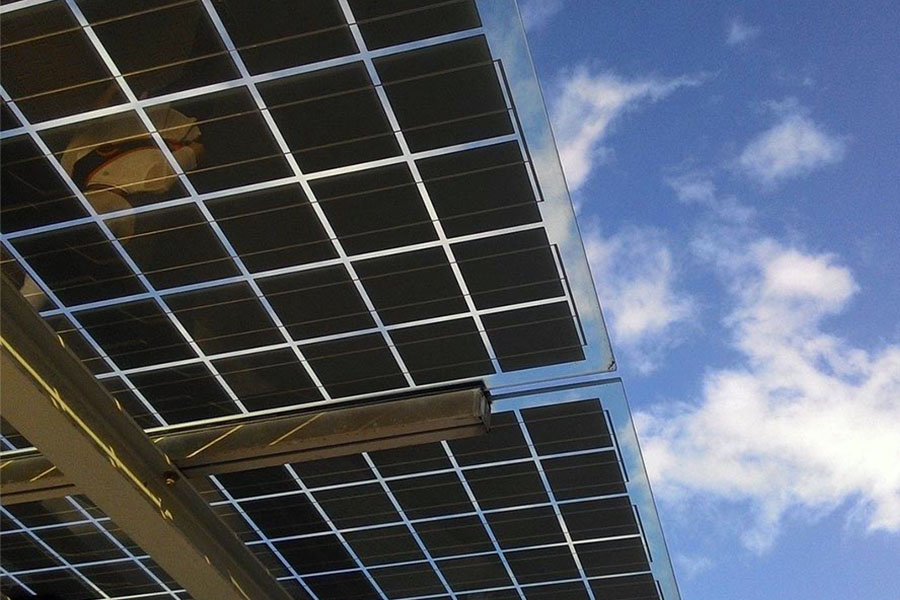
Bifacial solar panels are photovoltaic modules that generate electricity from both the front and rear faces of the panel, capturing reflected light from the ground or surrounding surfaces through the rear face.
At a Glance: A bifacial panel works like a standard panel from the front, absorbing direct sunlight. The rear face captures light bouncing back from whatever surface lies beneath the array. Total output is the sum of both.
What makes this possible is the construction, not the cells:
- Standard panels have an opaque backsheet that blocks light from reaching the rear entirely.
- Bifacial modules replace that backsheet with either a transparent rear sheet or a dual-pane double-glass construction, exposing the rear cells to reflected light.
- The solar cells themselves are identical to those in monofacial panels. The difference is purely in how the panel is assembled around them.
PERC (passivated emitter rear cell) technology is what made bifacial modules commercially viable. It improves the rear cell’s ability to convert light into electricity rather than losing that energy as heat. Without this improvement, the rear face would generate very little usable power even when reflected light was available.
How Bifacial Panels Differ from Monofacial Solar Panels
A monofacial solar panel has a solid, opaque rear backsheet. It protects the cells but blocks all light from the rear. A bifacial module uses a transparent rear layer, typically glass, so reflected light can reach the rear cells and generate additional current.
The cells in both panel types are made from the same monocrystalline silicon base material, the difference is purely structural. That one change means a bifacial module can produce power from two directions simultaneously, while a monofacial panel can’t. Understanding how solar panels work at the cell level helps explain why this structural difference matters to overall system output.
| Monofacial | Bifacial | |
| Rear backsheet | Solid, opaque | Transparent or double-glass |
| Rear-side generation | None | Yes, from reflected light |
| Cell material | Monocrystalline silicon | Monocrystalline silicon (same) |
| Generates from | Front only | Front and rear |
How Do Bifacial Solar Panels Work?
Bifacial solar panels work through the same photovoltaic process as any solar panel on the front face: photons from sunlight strike the monocrystalline silicon cells, dislodge electrons, and generate a direct current. The rear face operates on the same principle, but the photons it receives are reflected, not direct.
The amount of reflected solar irradiance reaching the rear cells depends entirely on what lies beneath the panel. A surface that reflects a large proportion of incoming light will send more photons toward the rear face. A dark or absorptive surface will send very few. This relationship is described by the albedo effect.
The Role of the Albedo Effect in Rear-Side Power Generation
Albedo is a measure of surface reflectivity, on a scale from 0 to 1. A surface with an albedo of 0 absorbs all incoming light; a surface with an albedo of 1 reflects all of it.
What that looks like in practice:
- Fresh snow: around 0.8
- White gravel or light-coloured concrete: around 0.5 to 0.6
- Standard roof tiles: 0.1 to 0.2
- Dark asphalt: around 0.05
These figures matter because they directly govern how much reflected light reaches the rear face of a bifacial module. A ground-mounted system over white gravel delivers substantially more rear-side irradiance than a rooftop system where the panel sits above dark tiles.
Ground clearance matters just as much. The rear face can only capture reflected light if there’s enough physical space between the panel underside and the surface below for light to enter, bounce back, and actually reach it.
What Is the Bifaciality Factor and Why Does It Matter?
The bifaciality factor is a product specification that expresses how efficiently the rear face of a bifacial module converts light, relative to the front face. It is stated as a percentage, typically between 65% and 90% for quality bifacial panels. A module with a bifaciality factor of 75% generates 75% as much power per unit of rear-side irradiance as it does from the same irradiance hitting the front.
When comparing bifacial modules, a higher bifaciality factor means the rear face performs closer to the front in terms of conversion efficiency. This translates to more additional output when reflected light is available.
Ask any installer specifying a bifacial module to confirm the bifaciality factor as part of the product data, and consider it alongside the panel’s overall rated power output rather than in isolation.
How Much Extra Energy Can Bifacial Solar Panels Generate?
Industry evidence suggests bifacial modules produce between 5% and 20% more energy annually than equivalent monofacial panels under real-world conditions. But the higher end of that range needs specific conditions:
- Elevated mounting with substantial rear clearance
- A high-albedo surface beneath the array
- Minimal shading of the rear cells
For a standard south-facing residential roof, typical tiles, near-flush mounting, the realistic gain is considerably more modest. 3% to 8% is a more representative figure for those setups. That’s not a reason to dismiss bifacial technology, but it is a reason not to assume the headline efficiency gains will show up on a typical residential roof.
To make this concrete: a 5kWp system generating 4,500kWh a year in the UK might realistically pick up an additional 200 to 400kWh annually from rear-side generation in a well-configured ground-mount over light-coloured gravel. The same system flush against dark roof tiles would see a much smaller contribution, closer to 150kWh or less. Over a 25-year system lifespan, that gap adds up significantly.
The International Energy Agency has tracked bifacial module deployment as part of its analysis of global solar technology trends, noting accelerating adoption in utility-scale and commercial ground-mounted applications where rear-side conditions can be optimised. For guidance on how much electricity a residential system generates in total, our article on how much electricity solar panels generate covers system sizing and output in detail.
When Bifacial Solar Panels Perform Best and When They Don’t
The performance advantage of bifacial panels is not fixed. It is governed by whether the installation configuration allows reflected light to reach the rear cells in useful quantities. Understanding the conditions that support or limit that is more useful than a generic pros and cons list.
Installations Where Bifacial Modules Deliver the Strongest Gains
Ground-mounted solar installations offer the best environment for bifacial technology:
- The installer can choose or prepare the ground cover beneath the array
- Panels can be mounted at optimal tilt and height
- Rear clearance is easy to achieve
- White gravel, pale concrete, or light-coloured aggregate delivers the high-albedo conditions that let the rear face contribute meaningfully to total energy yield
Commercial flat-roof arrays with elevated, tilted mounting frames and pale roof membranes also perform well:
- Panels sit well above the reflective surface
- Rear shading from mounting hardware is minimised
- The mounting system can be specified to reduce rail obstruction across the rear cells
Single-axis tracking systems, more common in solar farms than residential or small commercial settings, allow panels to follow the sun. This typically produces stronger bifacial gains, since the geometry between panel and ground changes throughout the day. Not a practical option for most UK homeowners, but worth noting when evaluating bifacial technology in larger commercial contexts.
Scenarios Where the Bifacial Advantage Is Limited
Flush or near-flush rooftop mounting significantly reduces rear-side generation. When a panel sits close to the roof, the gap beneath it is too narrow for reflected light to enter, bounce off the tiles, and reach the rear cells in any useful quantity. Even a technically bifacial panel will behave much like a monofacial one in that configuration.
Dark roof tiles compound the issue:
- Standard clay or concrete tiles have a low albedo, so there’s little reflected light available even with elevated mounting
- Combined with limited clearance, the rear-side contribution can end up negligible
For a small residential system, where the cost premium of bifacial modules over high-efficiency monofacial panels isn’t offset by meaningful additional generation, the financial case weakens considerably. A high-quality, well-oriented, correctly sized monofacial panel may represent better value in those circumstances. Our companion guide on bifacial solar panels, when do they make sense covers the practical decision criteria in more depth.
Stay Connected with Upvolt
Get the latest updates on energy innovations, smart solutions, and exclusive offers.
Are Bifacial Solar Panels Worth the Extra Cost?
Bifacial solar panels typically cost more per panel than equivalent monofacial ones, and whether that premium is worth it depends entirely on the installation:
- Residential rooftop, limited clearance: the cost premium may not be recovered through additional generation alone.
- Ground-mounted, commercial flat-roof, or elevated systems where 10 to 20% gains are achievable: the financial picture improves considerably.
The key concept here is levelised cost of energy (LCOE), the total cost of generating a unit of electricity over the system’s lifetime, accounting for installation, maintenance, and total output. A bifacial system generating 15% more electricity over 25 years has a meaningfully lower LCOE than its upfront premium suggests, since that extra energy comes at no additional running cost.
The principle is simple: the financial case is strongest where the installation is actually designed around bifacial’s requirements. Where the rear face will be shaded, obscured, or mounted against a low-albedo surface, a premium-grade monofacial panel may deliver stronger value per pound spent.
For homeowners researching the most advanced solar panel technology across product categories, bifacial modules are one of several directions panel engineering has taken in recent years.
How Upvolt Assesses Whether Bifacial Panels Are Right for Your Installation
Recommending bifacial panels without first assessing the mounting configuration, surface type, and available rear clearance is not good practice. The bifacial gain depends on all of those factors, and specifying bifacial modules as a default premium upgrade can lead to homeowners paying more for technology whose advantage cannot be realised at their site.
Site Assessment and Surface Conditions
What we find in practice is that the single most important variable for bifacial performance is not the panel specification but the space and surface beneath it. Before recommending bifacial or monofacial modules for any installation, we evaluate mounting configuration, the reflectivity of the roof or ground surface, estimated rear clearance, and rear shading from nearby structures or mounting hardware.
For residential solar panels, that assessment frequently shows that a flush-mounted rooftop system on standard tiles does not meet the conditions for meaningful rear-side generation. In those cases, the recommendation is typically a high-efficiency monofacial panel sized correctly for the roof and the household’s energy demand.
System Design for Maximum Energy Yield
Where site conditions do support bifacial technology, the system design should be built around maximising the albedo effect. That means specifying mounting height and tilt to allow rear clearance, selecting or recommending ground cover where possible, and choosing mounting hardware that minimises rear shading from rails and brackets.
Bifacial module selection is part of that design process, not separate from it. The bifaciality factor of the specified panel is reviewed alongside the rated power output and the projected rear-side irradiance for the site, rather than treated as a standalone specification.
Monitoring Performance with Skygate®
Once a system is installed, Upvolt’s Skygate® home energy management system enables homeowners and businesses to track actual energy yield over time. This makes it possible to identify whether the system’s real-world output aligns with the design projections, including whether rear-side generation is contributing as expected in bifacial installations.
Let’s Recap
Bifacial solar panels generate electricity from both faces, with the rear capturing light reflected from surfaces below and around the installation. The two variables that most determine whether that extra generation is actually realised are the bifaciality factor and the albedo of the surface beneath the array.
Gains of 5 to 20% above equivalent monofacial panels are achievable, but the higher end is more common in ground-mounted and commercial arrays than on a standard residential roof. For a flush-mounted roof over dark tiles, the realistic gain is more modest, and the cost premium should be weighed honestly against that.
The financial case is strongest where the installation is actually designed around bifacial’s requirements: elevated mounting, reflective ground cover, adequate rear clearance. Without those conditions, a high-efficiency monofacial panel may represent better value. Panel technology choice should follow the site assessment, not precede it.
For homeowners and businesses focused on maximising total output, the more useful question is often not monofacial versus bifacial, but how the whole system is designed, oriented, and monitored. Our companion guide covers that decision layer in more depth for those ready to evaluate their specific site.
About Upvolt
Upvolt is a renewable energy installer operating across southern England, specialising in solar panel installation for both residential and commercial properties. The technology choice for any solar installation, including whether bifacial or monofacial panels are appropriate, is determined by a site-specific assessment rather than a product catalogue default.
Upvolt installs residential and commercial solar panel systems, designs systems around actual usage patterns and site conditions, and integrates generation with battery storage and the Skygate® energy management platform for ongoing performance monitoring. Each system is designed to maximise energy yield for the specific property, not to meet a standard specification.
Upvolt’s MCS-certified operating companies carry out all solar installations to the standard required for Smart Export Guarantee (SEG) eligibility. The SEG is the mechanism through which homeowners are paid a rate by their energy supplier for surplus electricity exported to the grid, though the strongest financial return from solar comes from self-consumed generation rather than export income.
Whether bifacial or monofacial panels are the right fit depends entirely on your roof and site conditions, not a generic answer. Get a free, no-obligation quote and Upvolt will work out exactly what a system suited to your site would generate and save, before you commit to anything.
FAQ
Are Bifacial Solar Panels Worth It for a Standard Residential Roof?
For most flush-mounted residential rooftop installations, the rear-side generation advantage of bifacial panels is significantly reduced by the limited clearance between the panel and the roof surface. In these configurations, bifacial gain is typically in the 3 to 8% range rather than the headline figures associated with ground-mounted arrays. Whether the cost premium over a high-efficiency monofacial alternative is justified depends on the specific system size, roof surface type, and overall budget. An installer who assesses your site conditions before specifying a panel type will give you a more reliable answer than one who treats bifacial as a default premium product.
What Surface Produces the Most Reflected Light for Bifacial Panels?
The amount of reflected light available to the rear face depends on the albedo of the surface beneath the array. High-albedo surfaces such as white gravel, light-coloured concrete, pale roof membrane, and snow reflect significantly more light than dark asphalt, green turf, or standard roof tiles. Ground-mounted systems installed over high-albedo ground cover are best positioned to realise the full rear-side generation potential. For most residential rooftop installations, the tile surface has a relatively low albedo, which is one of the principal reasons bifacial gain is limited in those configurations.
How Does the Bifaciality Factor Affect Which Panel I Should Choose?
The bifaciality factor, typically between 65% and 90% for quality bifacial modules, expresses how efficiently the rear face converts light relative to the front face. A higher bifaciality factor means the rear face performs closer to the front, translating to more rear-side energy yield when reflected light is available. When comparing bifacial panel models, consider the bifaciality factor alongside overall power output rating rather than in isolation. Ask your installer to confirm the bifaciality factor for any bifacial module they specify.
Do Bifacial Solar Panels Need a Special Inverter or Mounting System?
Bifacial solar panels are compatible with standard string inverters and microinverters used in conventional photovoltaic systems. The inverter type does not need to change. The mounting system does matter: adequate clearance between the rear face and the surface below is required for rear-side light capture, and mounting rails should be specified to minimise shading across the rear cells. Some mounting systems are designed specifically for bifacial applications and are worth discussing with your installer when planning a bifacial system.
Can Bifacial Solar Panels Be Used in Commercial Installations?
Bifacial panels are widely used in commercial solar installations, particularly on flat roofs where elevated, tilted mounting frames provide rear clearance, and in ground-mounted arrays where the surface beneath can be chosen for high reflectivity. In those configurations, energy yield advantages of 10 to 20% are more reliably achieved than in standard residential rooftop installs, and the cost premium is more readily justified over the system’s lifetime. Commercial buyers evaluating bifacial panels should treat system design, mounting configuration, and ground surface type as integral parts of the financial case, not secondary considerations.

Alex Lomax
CEO & Co-Founder
Share article


Share article