-
Now live! Generate even more savings with our Skygate system. Click here to learn more.

On this page
- Can Solar Panels Be Installed on a Flat Roof?
- How Flat Roof Solar Mounting Systems Work
- What Is the Best Angle for Flat Roof Solar Panels in the UK?
- The Benefits and Drawbacks of Flat Roof Solar
- Do You Need Planning Permission for Flat Roof Solar Panels?
- Structural and Waterproofing Considerations Before Installing
- Maintenance and Long-Term Performance on a Flat Roof
- How Upvolt Designs and Installs Flat Roof Solar Systems
- Let's Recap
- About Upvolt
- FAQ
Renewable Energy Hardware
17 mins read
Can You Install Solar Panels on a Flat Roof?
26 Jul 2026When flat roof solar works well and what to consider before choosing a mounting system.
Take the first step toward energy independence today.
get a quote
On this page
- Can Solar Panels Be Installed on a Flat Roof?
- How Flat Roof Solar Mounting Systems Work
- What Is the Best Angle for Flat Roof Solar Panels in the UK?
- The Benefits and Drawbacks of Flat Roof Solar
- Do You Need Planning Permission for Flat Roof Solar Panels?
- Structural and Waterproofing Considerations Before Installing
- Maintenance and Long-Term Performance on a Flat Roof
- How Upvolt Designs and Installs Flat Roof Solar Systems
- Let's Recap
- About Upvolt
- FAQ
Solar panels work perfectly well on flat roofs, yet many homeowners with extensions, loft conversions, or garage roofs assume their property is unsuitable for solar because there is no natural pitch. The key questions are not about feasibility but about mounting method, roof condition, and orientation.
This guide explains how flat roof solar installations work, which mounting system suits which type of roof, and what to check before commissioning any work.

17 min read
On this page
- Can Solar Panels Be Installed on a Flat Roof?
- How Flat Roof Solar Mounting Systems Work
- What Is the Best Angle for Flat Roof Solar Panels in the UK?
- The Benefits and Drawbacks of Flat Roof Solar
- Do You Need Planning Permission for Flat Roof Solar Panels?
- Structural and Waterproofing Considerations Before Installing
- Maintenance and Long-Term Performance on a Flat Roof
- How Upvolt Designs and Installs Flat Roof Solar Systems
- Let’s Recap
- About Upvolt
- FAQ
Key Takeaways
- Solar panels can be installed on a flat roof using ballasted tub systems, penetrative frame fixings, or east/west split arrays, with the right approach determined by the roof’s construction, age, waterproofing membrane, and structural load capacity.
- The optimal tilt for south-facing flat roof solar in the UK is typically around 30 degrees from horizontal, with east/west split arrays tilted at a shallower 10 to 15 degrees to reduce wind loading and spread generation across a longer daily period.
- Penetrative fixings drilled through a modern single-ply membrane such as Sarnafil, Bauder, or IKO can void the manufacturer’s waterproofing warranty, which on newer roofs may run to 20 to 25 years, making the mounting system choice a financial consideration as well as a structural one.
- To qualify for the Smart Export Guarantee (SEG), the scheme under which energy suppliers pay for electricity exported to the grid, both the installation and components must meet Microgeneration Certification Scheme (MCS) requirements, regardless of whether the roof is flat or pitched.
Can Solar Panels Be Installed on a Flat Roof?
Quick Answer: Yes, solar panels can be installed on a flat roof. The panels are mounted on angled racking systems that compensate for the absence of natural roof pitch.
Flat roof solar is common on rear extensions, garage roofs, loft conversions, and single-storey commercial premises. These are exactly the building types where a pitched roof is either absent or unsuitable, making the flat section the most practical surface for solar panels on your property.
The absence of a natural pitch is not a disadvantage. On a pitched roof, the installer works around the existing geometry. On a flat roof, the installer sets the optimal angle directly. Roof condition and structural load-bearing capacity are the two prerequisite checks before any system can be specified.
How Flat Roof Solar Mounting Systems Work
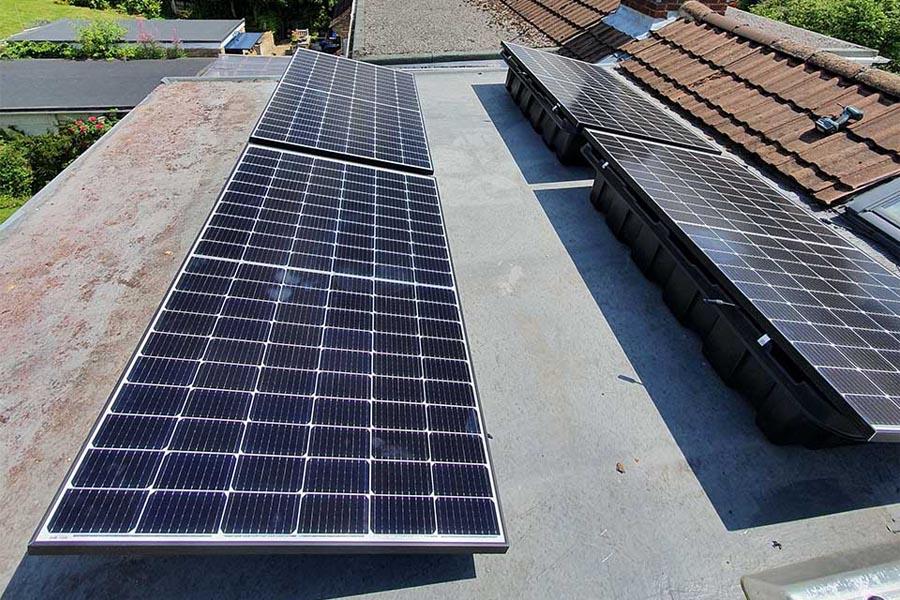
Flat roof solar panels are never laid flat against the surface. Panels installed without tilt suffer from water pooling, accelerated soiling, and significantly reduced output. Every flat roof system uses a racking structure to achieve a working tilt angle.
The three main mounting approaches are ballasted tub systems, penetrative A-frame or mini rail fixings, and east/west split arrays. Each suits a different combination of roof type, age, and structural condition. The table below summarises the key decision criteria.
| Mounting System | Roof Penetration Required | Suitable Roof Types | Typical Use Case |
| Ballasted tub | No | Most flat roofs with adequate load capacity | Residential extensions, commercial roofs with active membrane warranty |
| Penetrative A-frame / mini rail | Yes | Roofs where drilling is permitted by membrane warranty | Older flat roofs without active warranty; high wind exposure sites |
| East/west split array | Optional (ballasted or penetrative) | Roofs without clear south-facing orientation | Commercial roofs; residential where south is partially obstructed |
Ballasted Tub Systems
Ballasted systems sit on the roof surface and are held in position by weight, typically concrete ballast blocks, gravel, or paving slabs, rather than physical fixings into the roof structure. This approach preserves the waterproofing membrane entirely, which matters significantly if the roof is covered by an active manufacturer warranty.
A few things to know before specifying one:
- The roof must carry the combined distributed weight of the racking, panels, and ballast.
- Industry guidance typically requires a minimum distributed load tolerance of around 1.5 to 2.0 kN/m² before a ballasted system can go ahead.
- For any flat roof of uncertain age or construction history, a structural engineer’s assessment is a worthwhile step before system design begins.
Penetrative A-Frame and Mini Rail Systems
Penetrative systems are mechanically fixed into the roof substrate, offering greater wind resistance and a lower profile than ballasted tubs. The trade-off is real:
- Drilling through a flat roof membrane, particularly modern single-ply systems like Sarnafil, Bauder, or IKO, can void the manufacturer’s product warranty if the penetrations aren’t made to the manufacturer’s technical guidance.
- Some manufacturers require this work to be carried out by a registered contractor.
- For a roof with 15 years or more of warranty remaining, this is a meaningful financial consideration.
A reputable installer will check the membrane specification before recommending a penetrative approach, and confirm the warranty position with the membrane supplier before work begins. The National Federation of Roofing Contractors (NFRC) publishes guidance on roof penetrations that experienced flat roof solar installers will be familiar with.
East/West Split Arrays
Where a flat roof lacks a clear south-facing orientation, a split east/west array uses back-to-back angled racking to spread generation across a longer daily period. Rather than a single midday peak, the system produces electricity from early morning through to late afternoon. In our experience, east/west orientations consistently outperform owner expectations for households with high morning and evening energy demand.
A few things worth knowing:
- East/west arrays are common on commercial flat roofs and increasingly specified for residential extensions.
- The typical mounting angle is shallower, often 10 to 15 degrees, which reduces wind loading and the gap needed between panel rows.
- The trade-off is that more roof area is required per kW than a south-facing array at 30 degrees.
What Is the Best Angle for Flat Roof Solar Panels in the UK?
The optimal tilt angle for south-facing flat roof solar panels in the UK is typically around 30 degrees from horizontal, though systems at 10 to 15 degrees are common where roof space or wind loading is a constraint. A steeper angle increases annual yield, but it also increases wind loading on the racking and requires a larger gap between panel rows to avoid self-shading, which reduces how many panels fit on a given roof area.
A few practical points:
- Panels tilted at 10 degrees or more shed rainwater effectively, reducing soiling accumulation.
- Below that threshold, the self-cleaning effect diminishes and inspections become more frequent.
- For east/west split arrays, a tilt of 10 to 15 degrees is typical, balancing output with a lower wind uplift profile.
The right angle for any specific installation is a product of orientation, available roof area, wind exposure zone, and the mounting system chosen. There’s no single figure that applies universally, these variables are resolved at site survey stage.
The Benefits and Drawbacks of Flat Roof Solar
A flat roof brings genuine advantages over a pitched surface, but it also introduces trade-offs that are worth understanding before committing to a system.
Benefits
| Factor | Why It Helps |
| Orientation | Installer sets the optimal angle regardless of which way the building faces |
| Access | Easier to reach for cleaning and periodic inspection |
| Visibility | Typically less visible from the street |
Drawbacks
| Factor | Why It Matters |
| Roof area | More area required per kW due to inter-row spacing |
| Wind loading | Greater exposure than a pitched roof; affects ballast and structural requirements |
| Waterproofing | Penetrative fixings carry a warranty risk that doesn’t arise on a tiled pitched roof |
| Cost | Modest premium over an equivalent pitched roof system |
Why Flat Roof Solar Can Outperform Pitched Roof Systems
A flat roof gives the installer direct control over panel orientation and tilt. Where a pitched roof constrains the system to the existing geometry, a flat roof allows the optimal angle to be set regardless of which direction the building faces. For properties where the main pitched roof faces north or is heavily shaded, a flat-roofed extension or garage often makes the stronger case for solar.
Flat roofs are also easier to access for cleaning and periodic inspection. Understanding how much electricity solar panels generate over a year depends partly on keeping the panels clean, and straightforward access reduces both the cost and frequency of maintenance visits. Panels on a flat roof are typically less visible from the street, which is a practical consideration for homeowners in residential areas.
Where Flat Roof Solar Creates Additional Complexity
Flat roof systems require greater roof area per kW than on-roof pitched systems. Inter-row spacing to prevent self-shading between panel rows accounts for a meaningful portion of the available surface. Industry evidence suggests flat roof installations carry a modest cost premium over equivalent pitched roof systems, owing to the additional racking hardware and, where applicable, structural assessment requirements.
Wind loading exposure is a greater consideration on a flat roof than on a pitched surface. Ballast weight requirements and structural load calculations both reflect local wind speed data, and for exposed sites, these factors can influence system size and layout.
The waterproofing warranty risk associated with penetrative fixings is an additional financial consideration that does not arise on a tiled pitched roof installation.
Do You Need Planning Permission for Flat Roof Solar Panels?
In most cases, solar panels on a flat roof in England fall under permitted development rights and don’t require a formal planning application. A few conditions must be met:
- Panels must not protrude more than one metre above the highest part of the roof.
- The property must not be a listed building.
- The installation must not be on a property within certain designated areas, such as conservation areas, Areas of Outstanding Natural Beauty, or World Heritage Sites.
Panels facing onto a highway may be subject to additional conditions in certain configurations, and local planning authorities can apply their own specific requirements. If your property sits in any designated area, confirmation from the local authority is needed before any installation proceeds. The Planning Portal sets out the current permitted development conditions for solar panels in England.
Permitted development rules in Wales, Scotland, and Northern Ireland differ from those in England, so if you’re outside England, confirm your position with the local planning authority before commissioning any work. Our guide to planning permission for solar panels in the UK covers the conditions across property types in detail.
Structural and Waterproofing Considerations Before Installing
Two pre-installation checks are specific to flat roofs and should be addressed at survey stage. Neither is a reason to rule out solar installation, but both shape which mounting system is appropriate and whether the timeline for installation needs to account for additional professional assessments.
Does Your Flat Roof Have the Load-Bearing Capacity for Solar?
A ballasted mounting system adds significant distributed weight to a roof structure. The racking, panels, and ballast combined can add a load that older or lighter-constructed flat roofs were not designed to carry. Industry guidance typically requires confirmation of adequate distributed load tolerance before a ballasted system can be specified, and for any roof of uncertain construction or age, a structural engineer’s assessment provides that confirmation.
Skipping this step carries a practical consequence: if a roof is later found to lack adequate capacity, the system may need to be redesigned around penetrative fixings or reduced in size, both of which carry additional cost and disruption after installation has begun.
Will Solar Installation Affect My Flat Roof Waterproofing Warranty?
Modern flat roof membranes from manufacturers such as Sarnafil, Bauder, and IKO carry product warranties of up to 20 to 25 years. Drilling through that membrane without following the manufacturer’s technical guidance can void the warranty entirely. For a roof with 18 years of warranty remaining, that represents a meaningful financial exposure.
Ballasted systems avoid this risk because they do not penetrate the membrane. Where the roof is under five years old or carries an active manufacturer warranty, obtaining the warranty document before a mounting system is selected is a practical first step. The installer should confirm with the membrane supplier how the proposed fixing method interacts with the warranty before any work proceeds.
Maintenance and Long-Term Performance on a Flat Roof
Flat roof systems are generally easier to access for cleaning and inspection than pitched roof installations, a practical advantage over the lifetime of the system that reduces the cost of periodic maintenance. Our guide to solar panel maintenance covers the tasks and their frequency in full.
A couple of things worth knowing:
- Systems tilted below 15 degrees accumulate soiling faster, since the self-cleaning effect of rainfall diminishes at shallower angles, so more frequent inspection is a reasonable expectation.
- Mounting frames can redirect rainwater runoff across the roof surface. A poorly designed system can channel water toward existing drainage outlets or, in some cases, obstruct them entirely.
A well-designed installation accounts for drainage routes as part of the system layout, and it’s a reasonable question to ask whether this is addressed explicitly in the survey report.
Stay Connected with Upvolt
Get the latest updates on energy innovations, smart solutions, and exclusive offers.
How Upvolt Designs and Installs Flat Roof Solar Systems
Getting a flat roof installation right starts long before any equipment is chosen, it begins with understanding the roof itself.
Site Survey and Structural Assessment
Every flat roof solar installation begins with a site assessment. Upvolt’s MCS-certified operating companies survey roof orientation, available area, structural load capacity, waterproofing membrane status, and any nearby shading before a mounting system is recommended. The survey output determines whether a ballasted, penetrative, or east/west split approach is appropriate for that specific roof.
For any roof where the construction history is unclear or the membrane warranty is active, the survey stage includes the checks that protect both the property owner and the installation against downstream problems. The mounting system recommendation follows from the survey findings, not from a default preference.
Mounting System Selection and Installation
Upvolt installs flat roof solar systems on residential properties, including extensions, loft conversions, and garages, as well as smaller commercial premises across southern England and the Home Counties. All installations are completed by Upvolt’s MCS-certified operating companies to MCS standards, which is the requirement for qualifying for the Smart Export Guarantee (SEG). Commissioning an installation from a non-MCS installer removes SEG eligibility for the life of the system, as set out under Ofgem’s SEG framework.
System Monitoring After Installation
Once a flat roof system is commissioned, Skygate® is available as a monitoring and energy management platform. Skygate® integrates solar output with battery storage, EV charging, and heat pump data into a single view, allowing a property owner to track generation and self-consumption in real time. For homeowners considering adding battery storage to a solar system at a later stage, Skygate® simplifies that integration.
Let’s Recap
Flat roof solar is a viable, often well-performing option for extensions, loft conversions, garages, and smaller commercial properties. The absence of a fixed pitch is often an advantage, the installer can set the optimal tilt rather than working around existing geometry. The system works the same way as an on-roof pitched installation but needs additional racking to achieve the working angle.
The mounting system is the most consequential decision here. Ballasted tubs preserve the waterproofing membrane and any warranty but need the roof to carry a meaningful distributed load. Penetrative systems offer lower wind exposure and a smaller footprint but interact with the membrane in ways that can affect warranties. East/west split arrays suit roofs without a clear south-facing orientation, producing a flatter generation curve for morning and evening demand.
Two checks matter before any system is designed: a structural load assessment, and a waterproofing warranty review. A roof that doesn’t immediately pass either isn’t necessarily unsuitable, the design may just need to adapt.
Planning permission is straightforward for most residential cases under permitted development, but listed buildings, conservation areas, and some designated properties fall outside it and need a formal application. Confirming this early avoids a costly retrospective process, or worse, having to remove panels.
About Upvolt
Upvolt is a renewable energy installer serving homeowners and businesses across southern England and the Home Counties. Flat-roofed extensions, loft conversions, garages, and smaller commercial buildings are a regular installation context for Upvolt’s teams, covering both the mounting system selection and the pre-installation checks that determine whether a ballasted or penetrative approach is appropriate for a specific roof.
Upvolt’s MCS-certified operating companies carry out site surveys, mounting system design, and installation to MCS standards. This is the standard required for SEG qualification, meaning every installation Upvolt completes is eligible for export payments from the outset. The survey process covers roof orientation, structural load capacity, waterproofing membrane status, and shading, so the system recommended is matched to the actual conditions of the property rather than a generic specification.
For property owners who want to monitor their flat roof system alongside other home energy technology, Skygate® is available as an integrated platform covering solar, battery, EV, and heat pump data in one place.
Not sure which mounting system your flat roof actually needs, or whether it makes a strong financial case for solar? Get a free, no-obligation quote and Upvolt will survey your specific roof, structure, and orientation to give you real numbers, no guesswork, before you commit to anything.
FAQ
Is a Flat Roof Suitable for Solar Panels If It Faces North?
A flat roof does not face in a single direction in the way a pitched roof does, which is one of its practical strengths. Panels mounted on a flat roof can be oriented in any direction using the racking structure, regardless of the building’s orientation. For a north-facing property, this typically means specifying a south-facing array on the flat roof or an east/west split where south is partially obstructed. The installer confirms the optimal orientation at survey stage based on the specific layout and any nearby shading sources.
How Much More Does It Cost to Install Solar on a Flat Roof Compared to a Pitched Roof?
Flat roof installations typically carry a modest cost premium over equivalent pitched roof systems. The additional cost reflects the racking hardware required to achieve the working tilt and, where applicable, structural assessment fees. Ballasted systems add the cost of the ballast material and tray racking; penetrative systems add drilling and weatherproofing labour. Per-panel costs vary considerably with system size, roof accessibility, and equipment choice, so a site-specific survey is the most reliable basis for a cost estimate.
Can I Add Battery Storage to a Flat Roof Solar System?
Battery storage can be added to any grid-tied flat roof solar installation in the same way it applies to a pitched roof system. The battery is typically wall-mounted internally and connected to the inverter, so the flat roof mounting method does not affect compatibility. Adding storage allows generated electricity to be retained for use in the evening rather than exported at lower SEG rates, which is often where the strongest financial case for storage lies. Whether storage makes sense depends on household usage patterns and the size of the solar system.
Will Flat Roof Solar Panels Affect My Roof Drainage?
Mounting frames can redirect rainwater runoff if drainage is not considered during system design. A poorly specified installation can channel water toward low points or partially obstruct existing drainage outlets, leading to pooling on the roof surface. A well-designed installation accounts for the existing drainage routes and ensures the racking layout does not obstruct them. This is a routine part of the site survey process, and asking the installer to confirm how drainage is addressed in the system design is a reasonable step before works are agreed.
Do I Need MCS-Certified Installers for a Flat Roof Solar Installation to Qualify for the Smart Export Guarantee?
Yes. To qualify for the Smart Export Guarantee (SEG), the scheme through which energy suppliers pay for electricity exported to the grid, both the installer and the components used must meet MCS requirements. This applies equally to flat roof and pitched roof installations. Using a non-MCS installer typically reduces upfront costs but removes SEG eligibility for the life of the installation. Understanding that financial consequence before selecting a contractor is an important part of evaluating the total cost of the installation.

Alex Lomax
CEO & Co-Founder
Share article


Share article