-
Now live! Generate even more savings with our Skygate system. Click here to learn more.

On this page
- Quick Answer: Which Battery Type Is Better Today?
- What's The Difference Between Flow Batteries And Lithium-Ion?
- Why Lithium-Ion Dominates Home Energy Storage Today
- Where Flow Batteries Could Have An Advantage
- The Reality Check: Are Flow Batteries Ready For UK Homes?
- Should You Wait for Flow Batteries?
- The Smarter Approach: Install What Works Today, Stay Ready For Tomorrow
- How Upvolt Helps Homeowners Choose The Right Storage Solution
- Let's Recap
- About Upvolt
- FAQ
Energy Storage
17 mins read
Flow Batteries Vs Lithium-Ion: Which Is Better For UK Homes?
14 Feb 2026How flow batteries and lithium-ion compare on cost, performance and real-world use in UK homes.
Take the first step toward energy independence today.
get a quote
On this page
- Quick Answer: Which Battery Type Is Better Today?
- What's The Difference Between Flow Batteries And Lithium-Ion?
- Why Lithium-Ion Dominates Home Energy Storage Today
- Where Flow Batteries Could Have An Advantage
- The Reality Check: Are Flow Batteries Ready For UK Homes?
- Should You Wait for Flow Batteries?
- The Smarter Approach: Install What Works Today, Stay Ready For Tomorrow
- How Upvolt Helps Homeowners Choose The Right Storage Solution
- Let's Recap
- About Upvolt
- FAQ
As more UK households install solar panels, battery storage has become the next big decision. But choosing a home battery is not about chasing the newest technology; it is about selecting something that works reliably within the constraints of a real home, real space, and real energy use. Lithium-ion batteries currently dominate the residential market, while flow batteries are often discussed as a future alternative.
This article explains how both technologies actually perform in UK homes, where each one fits, and why the right choice today depends less on theory and more on practicality, cost, and timing.

17 min read
On this page
- Quick Answer: Which Battery Type Is Better Today?
- What’s The Difference Between Flow Batteries And Lithium-Ion?
- Why Lithium-Ion Dominates Home Energy Storage Today
- Where Flow Batteries Could Have An Advantage
- The Reality Check: Are Flow Batteries Ready For UK Homes?
- Should You Wait for Flow Batteries?
- The Smarter Approach: Install What Works Today, Stay Ready For Tomorrow
- How Upvolt Helps Homeowners Choose The Right Storage Solution
- Let’s Recap
- About Upvolt
- FAQ
Key Takeaways
- Lithium-ion batteries are currently the most practical and cost-effective option for UK homes installing storage today.
- Flow batteries offer long lifespan and long-duration storage, but are not yet suitable for typical residential properties.
- Most UK households need fast, responsive daily energy shifting rather than multi-day storage capacity.
- Installing proven battery technology now delivers immediate savings without preventing future upgrades.
Quick Answer: Which Battery Type Is Better Today?
For most UK households installing battery storage now, lithium-ion is the practical choice. It is widely available, well understood by installers, and proven in everyday residential use. Other technologies exist, but they are not yet suited to typical homes.
Why Lithium-Ion Is the Current Standard
Lithium-ion batteries dominate home energy storage because they balance performance, size, and cost in real-world conditions. They work well with solar systems, time-of-use tariffs, and daily charge and discharge cycles.
For homeowners, this means:
- Reliable performance across daily cycling
- Compact systems that fit standard homes
- Established installer experience and support
- Clear warranties and predictable behaviour
This maturity matters more than headline specifications when the goal is dependable savings rather than experimentation.
Where Flow Batteries Fit (For Now)
Flow batteries take a different approach, separating energy storage from power delivery. In theory, this allows for longer lifespans and less degradation over time. In practice, current systems are large, expensive, and better suited to commercial or grid-scale use than domestic settings.
At present, flow batteries:
- Require significantly more space
- Carry higher upfront costs
- Lack residential installer coverage in the UK
- Offer limited integration with home energy systems
They remain a future technology rather than a realistic option for most homes today.
The Practical Takeaway for Homeowners
If you are installing a home battery now, lithium-ion is the sensible choice. It delivers predictable performance, integrates cleanly with solar and smart tariffs, and avoids unnecessary complexity. Alternative battery technologies may mature over time, but today they add risk without clear household benefit.
What’s The Difference Between Flow Batteries And Lithium-Ion?
Battery technology has grown a lot, with two main types for home energy: lithium-ion and flow batteries. Knowing how they store energy helps you choose the best for your home.
How Lithium-Ion Stores Energy
Lithium-ion batteries use complex chemical reactions in small cells. They work by moving lithium ions between electrodes during charge and discharge.
- Energy is stored through chemical reactions within solid battery cells
- Lithium ions move through a liquid electrolyte medium
- Power output is directly linked to the battery cell’s physical structure
How Flow Batteries Store Energy
Redox flow batteries store energy differently. They use liquid solutions in tanks outside the battery, offering a new way to manage power.
- Batteries store energy in liquid form within separate electrolyte tanks
- Liquid electrolytes are pumped through a central electrochemical cell
- Redox reactions generate and store electrical energy
The Key Operational Difference: Energy Capacity Vs Power Output
The main difference is in how they scale. Lithium-ion batteries have both energy and power in one cell. Flow batteries can grow energy storage by adding tank size, giving more flexibility for your home.
Why Lithium-Ion Dominates Home Energy Storage Today
Lithium-ion and flow batteries store energy in fundamentally different ways. That difference explains why one dominates UK homes today, while the other remains largely experimental in residential settings.
How Lithium-Ion Batteries Store Energy
Lithium-ion batteries store energy inside sealed cells using controlled chemical reactions. When the battery charges and discharges, lithium ions move between internal electrodes, releasing electricity instantly when needed.
In practical terms:
- Energy is stored inside compact, self-contained cells
- Power delivery is fast and predictable
- Energy capacity and power output are fixed together within the battery unit
This tight integration makes lithium-ion systems efficient, responsive, and easy to install in homes.
How Flow Batteries Store Energy
Flow batteries separate energy storage from power delivery. Energy is held in liquid electrolytes stored in external tanks, which are pumped through a central cell when electricity is needed.
This design means:
- Energy is stored in liquid form outside the battery core
- Power is generated only when electrolytes circulate
- Storage capacity increases by adding larger tanks, not more cells
While technically elegant, this setup introduces complexity that limits residential practicality.
The Key Operational Difference: Energy Capacity vs Power
Lithium-ion batteries scale by adding more battery units, increasing both power and storage together.
Flow batteries scale energy independently from power, which can be useful at large scale but unnecessary for most homes.
For households, this matters because:
- Homes need fast, responsive power more than long-duration storage
- Daily cycling matters more than multi-day discharge capability
- Simplicity and footprint outweigh theoretical flexibility
This is where lithium-ion aligns better with real household energy use.
Where Flow Batteries Could Have An Advantage
Flow batteries are not designed to replace lithium-ion systems in most homes today, but they do offer characteristics that could become valuable as home energy needs grow and diversify. Their strengths lie in duration, longevity, and scalability rather than compactness or short-term payback.
Built for Long-Duration Energy Storage
Flow batteries excel at storing energy over extended periods. Storage duration is determined by tank size rather than the battery core, which allows systems to deliver power for many hours without stressing the battery.
This makes them well-suited to:
- Long overnight energy supply rather than short evening peaks
- Homes aiming to cover extended low-generation periods
- Scenarios where energy is stored once and released slowly
For households prioritising duration over fast cycling, this is a meaningful distinction.
Exceptionally Long Operational Lifespan
Flow batteries can operate for decades because their energy storage medium does not degrade in the same way as solid battery cells. In theory, many systems can last 20 to 25 years with minimal loss of capacity.
That longevity matters for:
- Long-term energy resilience planning
- Applications where replacement cycles are disruptive or costly
- Owners prioritising durability over compact design
In lifespan terms, flow batteries behave more like infrastructure than appliances.
Minimal Capacity Degradation Over Time
Unlike lithium-ion batteries, flow batteries experience very little wear from repeated charging and discharging. The liquid electrolyte can be reused or refreshed, which keeps performance stable across thousands of cycles.
This characteristic supports:
- Consistent energy availability year after year
- High cycle counts without accelerated ageing
- Predictable long-term output rather than gradual decline
For applications where stability matters more than responsiveness, this is a clear advantage.
Scalable for Very High Energy Demand
Flow batteries separate energy storage from power delivery, which allows capacity to grow simply by increasing tank volume. This makes them attractive where energy demand is unusually high or expected to grow significantly.
This scalability suits:
- Large properties or multi-building sites
- Homes combining heating, EV charging, and extended backup
- Future scenarios where daily energy use increases sharply
In these contexts, flow batteries offer flexibility that lithium-ion systems struggle to match.
The Reality Check: Are Flow Batteries Ready For UK Homes?
Flow batteries attract attention because of their longevity and long-duration storage potential, but today they remain poorly suited to most UK homes. While the technology is proven at scale, significant practical barriers limit its residential use.
Limited Residential Availability
Flow batteries are rarely deployed in homes. Most manufacturers focus on commercial, industrial, or grid-scale energy storage, where space, cost, and system complexity are less restrictive.
In the UK, this means:
- Very few residential-grade flow battery products
- Limited installer experience in domestic settings
- Long lead times and bespoke system design
For homeowners, availability alone remains a major constraint.
Size and Installation Constraints
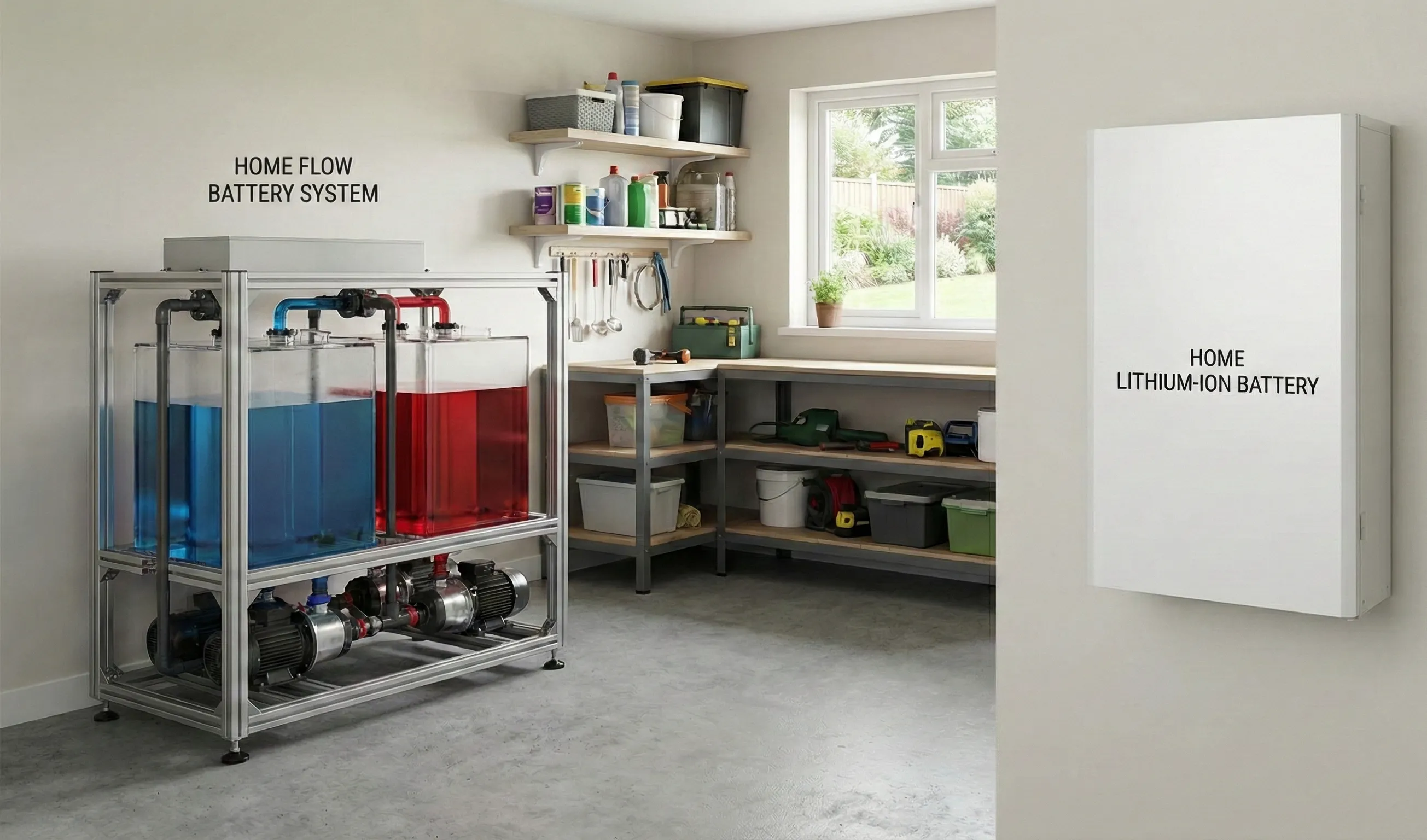
Flow batteries require substantially more space than lithium-ion systems. Energy is stored in external liquid tanks, which increases both footprint and installation complexity.
| Battery Type | Typical Footprint | Installation Complexity |
| Lithium-ion | Compact, wall-mounted | Low |
| Flow battery | Large tanks and plant space | High |
Most UK homes lack the spare indoor or outdoor space needed to install flow batteries without major building work.
Higher Upfront Costs
Flow batteries currently carry significantly higher installation costs than lithium-ion systems. While their long lifespan can improve lifetime value in theory, the upfront investment remains difficult to justify for typical households.
As a result:
- Payback periods are longer and less predictable
- Financing options are limited
- Cost savings rarely outperform lithium-ion in domestic use
For most homeowners, cost alone rules flow batteries out today.
Why Installers Still Recommend Lithium-Ion
Lithium-ion batteries dominate the residential market for practical reasons rather than trend or hype.
Installers favour them because they:
- Have a long track record in UK homes
- Fit into limited residential spaces
- Integrate easily with solar, EV chargers, and smart tariffs
- Are supported by mature supply chains and warranties
Flow batteries simply do not yet offer the same reliability or support at household scale.
Which Battery Performs Better for Typical UK Usage?
The right battery depends on how energy is actually used in UK homes, not on theoretical advantages.
Daily Solar Energy Shifting
Most households use batteries to store daytime solar generation and release it in the evening. Lithium-ion batteries are highly efficient at this task, typically delivering efficiencies above 90%.
This makes them well-suited to:
- Daily charge and discharge cycles
- Evening peak demand reduction
- Maximising solar self-consumption
Flow batteries offer no clear advantage for this common use case.
Evening and Overnight Consumption
Typical UK households require a few hours of stored energy in the evening rather than all-night discharge. Lithium-ion batteries deliver steady output over this period without oversizing.
Flow batteries are capable of longer discharge, but that additional duration is rarely needed in normal residential patterns.
Backup Power Expectations
When grid outages occur, responsiveness matters more than endurance. Lithium-ion batteries provide:
- High surge power for appliances
- Fast response times
- Reliable performance during short outages
Flow batteries are less suited to sudden high-demand loads common in domestic backup scenarios.
Integration With Electric Vehicles
As EV adoption increases, homes benefit from flexible, modular storage. Lithium-ion systems scale more easily alongside EV charging and future upgrades.
Flow batteries, by contrast, require significant redesign to expand capacity, which limits adaptability in evolving home energy systems.
Should You Wait for Flow Batteries?
For most UK households, waiting for flow batteries means waiting while energy bills keep arriving. Flow batteries may improve over time, but the financial reality today is that delaying storage often costs more than it saves.
The Hidden Cost of Waiting
Every month without a battery system is a month where:
- Excess solar is exported at low rates
- Evening electricity is bought back at peak prices
- Savings that could be locked in now are lost
For a typical solar home, that delay can mean hundreds to over a thousand pounds per year in unrealised savings, depending on usage and tariffs. Waiting is not neutral. It has a cost.
Flow Batteries Will Not Replace Lithium-Ion Overnight
Battery technology will continue to evolve, but residential energy does not shift in sudden leaps. Even if flow batteries become viable for homes, adoption will be gradual due to cost, space, installer capability, and regulation.
Lithium-ion systems are not a temporary stopgap. They are:
- Actively improving in lifespan and safety
- Supported by mature supply chains
- Compatible with future EV charging and smart energy platforms
Installing lithium-ion today does not block future upgrades. It enables savings now.
Modern Systems Reduce the Risk of “Getting It Wrong”
Current home battery systems are designed to be modular and flexible. Capacity can often be expanded, software updated, and control systems upgraded without replacing the core installation.
That means:
- You can start capturing value immediately
- Future improvements do not require starting again
- The system adapts as your home energy use changes
Waiting for “perfect” technology often means missing years of real, bankable savings.
When Waiting Might Actually Make Sense
There are limited situations where holding off is reasonable:
- Major renovations planned that will reshape energy demand
- Very high, long-duration storage needs beyond typical homes
- Solar or EV installation still several years away
Outside of these cases, delaying usually reduces total lifetime value.
The Practical Decision
The choice comes down to whether you value guaranteed savings today or the possibility of different technology later. The comparison below shows how installing a lithium-ion battery now stacks up against waiting for flow batteries to become viable for UK homes.
| Factor | Install Lithium-Ion Now | Wait for Flow Batteries |
| Start saving immediately | Yes | No |
| Reduce evening grid costs | Yes | No |
| Compatible with EVs and smart tariffs | Yes | Uncertain |
| Risk of missed savings | Low | High |
The Smarter Approach: Install What Works Today, Stay Ready For Tomorrow
The best energy decisions balance certainty with flexibility. For most UK homes, that means choosing proven battery technology that delivers savings now, while making sure today’s installation does not block better options later. Waiting for perfect technology often means paying higher bills in the meantime.
Why Proven Technology Usually Wins Financially
Lithium-ion batteries are the clear leader in today’s home energy market because they already solve the problem homeowners actually face: high evening electricity costs. They are widely supported, predictable to run, and backed by established warranties and installer experience.
This translates into:
- Immediate reductions in grid electricity use
- Known performance and lifespan expectations
- Lower financial and technical risk than emerging alternatives
How Modern Systems Stay Upgrade-Friendly
Choosing lithium-ion does not mean locking your home into a dead end. Many current battery systems are modular, allowing capacity to be expanded or reconfigured as household demand changes. This preserves flexibility without delaying savings.
A well-designed system:
- Allows additional battery modules to be added later
- Integrates with EV charging and smart tariffs
- Avoids proprietary layouts that restrict future upgrades
Plan Storage Around What Your Home Will Need Next
Energy demand rarely stays static. EV charging, home working, and electrified heating all increase electricity use over time. Battery storage should be sized for today’s needs, but designed with tomorrow in mind.
Planning ahead means:
- Avoiding oversized systems that take years to pay back
- Ensuring space and capacity for future expansion
- Designing around realistic household usage rather than peak scenarios
Why Installer Choice Matters as Much as the Battery
Battery hardware is only part of the decision. Installers determine whether a system remains adaptable or becomes a constraint. The right partner designs for long-term performance, not just installation day.
Look for installers who:
- Design systems around future energy scenarios
- Use open, upgradeable platforms
- Explain how today’s choices affect tomorrow’s options
upvolt_hubspot_form
How Upvolt Helps Homeowners Choose The Right Storage Solution
Choosing battery storage is not about buying the biggest battery or chasing new technology. It is about matching storage to how your home actually uses energy today, while keeping your options open for tomorrow.
Upvolt removes the guesswork by designing storage systems around real household behaviour, not generic assumptions.
Battery Storage Designed Around Real Household Usage
Upvolt starts with how energy flows through your home across the day, not headline system sizes. We analyse when electricity is used, how much solar generation is available, and where grid reliance is most expensive. This ensures the battery you install delivers measurable savings rather than unused capacity.
Our approach focuses on:
- Detailed analysis of household consumption and solar output
- Battery sizing that targets evening and peak-price demand
- Systems designed to pay back reliably, not just look impressive on paper
Systems Built to Adapt as Your Energy Needs Change
Household energy use evolves. Electric vehicles, home working, and electrified heating all increase demand over time. Upvolt designs battery systems with expandability in mind, so today’s installation does not become tomorrow’s limitation.
That means:
- Modular battery designs that allow capacity to be added later
- Electrical layouts that support future upgrades without rework
- Avoiding closed platforms that lock homeowners into fixed limits
EV Charging That Works With Your Energy System, Not Against It
EV charging can either increase costs or strengthen savings, depending on how it is integrated. Upvolt designs systems where battery storage, solar generation, and EV charging work together rather than competing for power.
This allows homeowners to:
- Charge EVs using surplus solar rather than peak-rate grid electricity
- Shift charging to lower-cost periods automatically
- Prepare for future bidirectional or smart charging without redesign
Skygate® Monitoring That Turns Data Into Decisions
Battery storage only delivers value if it performs as expected. Skygate® provides clear, real-time visibility into how energy is generated, stored, and used, removing uncertainty from system performance.
With Skygate®, homeowners can:
- Track battery charging, discharging, and grid reliance
- Verify savings rather than estimate them
- Identify opportunities to improve self-consumption over time
Upvolt combines proven battery technology, flexible system design, and clear performance insight to ensure storage decisions deliver confidence as well as savings.
Let’s Recap
Battery storage decisions work best when grounded in how homes actually use energy. For most UK households, lithium-ion batteries align well with daily solar generation, evening electricity demand, limited space, and predictable payback timelines.
Flow batteries remain an interesting technology, particularly for large or specialist applications, but their size, cost, and lack of residential availability mean they are not yet a realistic choice for most homes. Waiting for them to mature often means missing years of savings that proven systems can already deliver.
The smartest approach is not to wait for perfect technology, but to install what works now while designing systems that remain flexible as home energy needs evolve.
About Upvolt
Upvolt helps UK homeowners design smarter, more resilient home energy systems that deliver real savings today and remain ready for what comes next. Rather than pushing one-size-fits-all solutions, we design solar and battery systems around how each household actually uses energy – across the day, across seasons, and as demand changes over time.
From right-sized lithium-ion battery storage to EV-ready electrical layouts and intelligent system monitoring, our focus is on long-term performance, not short-term trends.
Want to understand which battery setup makes sense for your home? Complete our short online form to receive a personalised assessment and see how storage could work for you.
FAQ
What are the key differences between flow batteries and lithium-ion batteries?
Lithium-ion batteries store energy inside compact, sealed cells and deliver power quickly, making them well-suited to daily household use, such as evening demand and solar energy shifting. Flow batteries store energy in liquid electrolytes held in external tanks, separating storage capacity from power delivery. This allows longer storage durations and longer lifespans, but at the cost of much larger systems, higher complexity, and higher upfront cost.
Are flow batteries better for home energy storage in the UK?
For most UK homes, no. While flow batteries offer theoretical advantages such as long lifespan and minimal degradation, they are currently too large, expensive, and complex for typical residential properties. Lithium-ion batteries better match UK homes because they fit limited spaces, integrate easily with solar and smart tariffs, and deliver fast, responsive power.
How long do flow batteries last compared to lithium-ion batteries?
Flow batteries can last 20–25 years with minimal capacity loss because their liquid electrolyte does not degrade like solid battery cells. Lithium-ion batteries typically last 10–15 years, depending on usage, chemistry, and operating conditions. However, for most households, lithium-ion batteries still deliver better overall value because their lower upfront cost and immediate savings outweigh the benefit of longer theoretical lifespan.
Should I wait for flow battery technology to improve before installing home energy storage?
In most cases, waiting does not make financial sense. While flow batteries may improve in the future, delaying storage often means exporting excess solar at low rates and buying expensive electricity in the evening. Proven lithium-ion systems deliver savings now and do not prevent future upgrades, especially when installed as part of a modular, flexible energy system.
Will flow batteries become cheaper than lithium-ion in the future?
Costs may fall as flow battery technology matures, but residential pricing is unlikely to undercut lithium-ion in the near term. Manufacturing scale, installer familiarity, and supply chains strongly favour lithium-ion for UK homes today.

Alex Lomax
CEO & Co-Founder
Share article


Share article