-
Now live! Generate even more savings with our Skygate system. Click here to learn more.

On this page
- Can Solar Panels Be Installed on a Slate Roof?
- How Solar Panels Are Fixed to a Slate Roof: The Step-by-Step Process
- Hook Mounts vs Bracket Mounts: Which Is Better for Slate?
- What to Check Before Installation Begins
- Planning Permission and Conservation Area Rules for Slate Roofs
- PV Slate Tiles: An Integrated Alternative to Standard Panel Mounting
- How Much Does It Cost to Install Solar Panels on a Slate Roof?
- Ground-Mounted Solar: When the Roof Is Not the Right Option
- How Upvolt Approaches Solar Installation on Slate Roofs
- Let's Recap
- About Upvolt
- FAQ
Renewable Energy Hardware
18 mins read
How Are Solar Panels Installed onto Slate Roofs?
1 Feb 2026Discover how Installation of solar panels on slate roofs works
Take the first step toward energy independence today.
get a quote
On this page
- Can Solar Panels Be Installed on a Slate Roof?
- How Solar Panels Are Fixed to a Slate Roof: The Step-by-Step Process
- Hook Mounts vs Bracket Mounts: Which Is Better for Slate?
- What to Check Before Installation Begins
- Planning Permission and Conservation Area Rules for Slate Roofs
- PV Slate Tiles: An Integrated Alternative to Standard Panel Mounting
- How Much Does It Cost to Install Solar Panels on a Slate Roof?
- Ground-Mounted Solar: When the Roof Is Not the Right Option
- How Upvolt Approaches Solar Installation on Slate Roofs
- Let's Recap
- About Upvolt
- FAQ
Slate roofs are one of the most demanding surfaces for solar installation, and the difference from a standard concrete tile roof is not cosmetic. Slate is a natural stone material: strong in compression, but brittle along its grain, and it cannot be treated the same way as a mass-produced concrete tile. For homeowners with Victorian terraces, Edwardian semis, or rural stone cottages, the question is rarely whether solar works in principle.
The real question is whether their specific roof makes installation practical, what the risks are, and what it will actually cost. This guide explains the installation process in full, what to check before installation begins, and the alternatives worth knowing about.

18 min read
On this page
- Can Solar Panels Be Installed on a Slate Roof?
- How Solar Panels Are Fixed to a Slate Roof: The Step-by-Step Process
- Hook Mounts vs Bracket Mounts: Which Is Better for Slate?
- What to Check Before Installation Begins
- Planning Permission and Conservation Area Rules for Slate Roofs
- PV Slate Tiles: An Integrated Alternative to Standard Panel Mounting
- How Much Does It Cost to Install Solar Panels on a Slate Roof?
- Ground-Mounted Solar: When the Roof Is Not the Right Option
- How Upvolt Approaches Solar Installation on Slate Roofs
- Let’s Recap
- About Upvolt
- FAQ
Key Takeaways
- Solar panels can be installed on slate roofs, but each fixing point requires individual slate removal, cutting, and refitting, making slate installations significantly more labour-intensive than equivalent work on concrete tiles.
- Older properties, particularly those built before 1950, may need a structural engineer’s assessment before installation, because solar panels add a deadload of typically 12 to 15kg per square metre to the roof structure.
- Permitted development rights that allow most residential solar installations without planning permission do not apply to listed buildings, and are commonly restricted in conservation areas, which are disproportionately home to natural slate roofs.
- PV slate tiles offer an integrated alternative that eliminates penetrating fixings entirely, and are often more suitable for properties being re-roofed or facing aesthetic and planning constraints.
Can Solar Panels Be Installed on a Slate Roof?
Solar panels can be installed on slate roofs, and experienced installers carry out these installations regularly across the UK.
Short answer: Yes, solar panels can be installed on slate roofs, but the process requires specialist techniques and takes significantly longer than installation on standard concrete tiles.
What makes slate different is its material character:
- Natural slate (Welsh, Cornish, or Spanish) is a quarried stone that splits cleanly along its grain but will crack unpredictably if drilled without care.
- Unlike concrete tiles, which tolerate direct fastening through the tile body, slate needs a fixing method that works around the tile rather than through it.
- This isn’t a minor variation, it changes how long the job takes, what tools are needed, and which installer qualifications matter.
It’s also worth knowing the difference between natural slate and reconstituted or fibre cement slate tiles, which are manufactured rather than quarried:
- Reconstituted slate is denser and more uniform, making it less prone to cracking under fixing pressure.
- The installation approach for reconstituted slate is closer to a standard concrete tile roof, though it still benefits from care during removal and refitting.
- If you’re unsure which type your roof has, a pre-installation survey will identify it.
If you’re considering solar panels for your home, the roof material is one of the first things a good installer will assess.
How Solar Panels Are Fixed to a Slate Roof: The Step-by-Step Process
Installing solar panels on a slate roof follows a clear sequence, but each stage is more time-consuming than the equivalent step on a concrete tile roof. Here is what the process involves at each point.
Marking the Array Position
Before any tile is touched, the installer maps the roof to identify where brackets will sit. Fascia lines, rafter positions, and joist spacings determine where the roof anchors can be fixed securely into the underlying timber. Getting this right at the outset prevents unnecessary tile disturbance later. A poorly planned array position wastes both time and slate.
Removing and Protecting the Slate Tiles
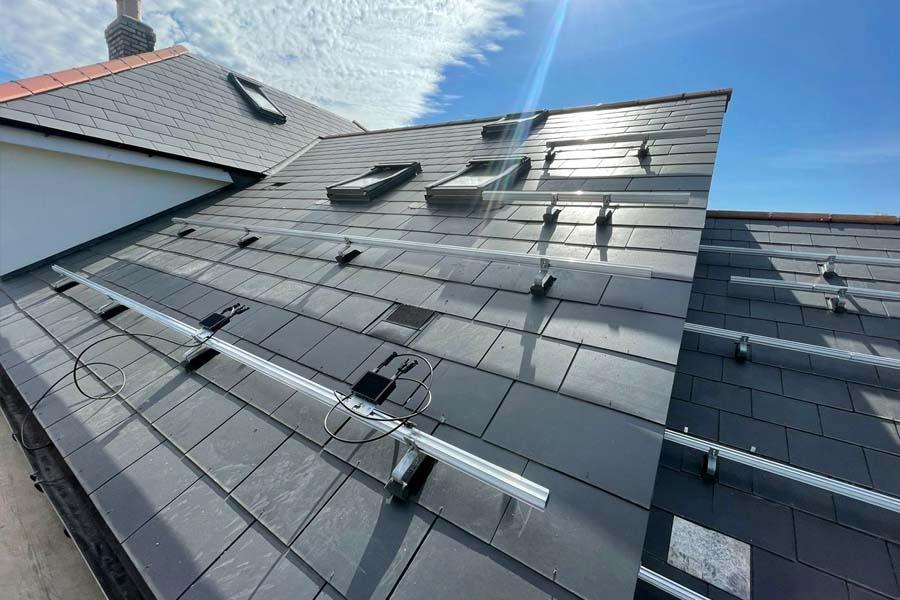
At each anchor point, the surrounding slate tiles must be lifted without cracking them. This is where a specialist tool called a slate ripper is used. The ripper slides under the tile and releases the nail holding it to the batten, allowing the tile to be removed cleanly. This stage is the slowest part of a slate roof installation. Each tile must be handled individually, set aside safely, and kept intact for refitting.
On an aged natural slate roof, tiles that have been in place for a century or more are particularly fragile, and in our experience this stage takes two to three times longer per fixing point than the equivalent step on a concrete tile roof.
Installing Roof Anchors and Flashing
With the tile removed, the installer fixes a roof anchor directly into the batten beneath. The anchor provides the structural connection point for the mounting rail that will carry the panels. Once the anchor is in place, lead or aluminium flashing is fitted around the penetration point to weatherproof it. This is not an optional extra.
The flashing requirement is set out under MCS 012, the Microgeneration Certification Scheme standard that governs solar installation workmanship. MCS 012 is a standard compliance requirement, not a premium feature. If flashing is not correctly seated, water can enter at the anchor point and cause damage behind the slates over time.
Cutting and Refitting the Tiles
The removed slate tile cannot simply be placed back over the anchor. It must be cut to fit around the flashing using a professional slate cutter, leaving the correct clearance without compromising the tile’s structural integrity. This is a skilled task. A tile cut too short leaves a gap that allows wind-driven rain to enter; a tile cut inaccurately will not sit flat against its neighbours. Once cut and checked, the tile is refitted around the flashing and secured back into position.
Mounting the Rails and Panels
With all anchors installed and tiles refitted, aluminium mounting rails are fixed across the anchor points. From this stage, the process is broadly the same as for any other roof type:
- Panels are secured to the rails using standard clamps.
- The system is connected to the inverter.
- The system is commissioned.
The complexity of a slate installation is concentrated in the fixing stage, once the rail structure is in place, the panel mounting itself is straightforward.
An alternative to the bracket-and-flashing system above is a hook mount, which clips over the upper edge of a slate tile rather than penetrating it:
- Hook mounts eliminate the need for flashing at each fixing point.
- They reduce tile disturbance during installation.
- They’re particularly relevant to older or more fragile natural slate.
The next section covers the comparison between the two approaches in detail.
Hook Mounts vs Bracket Mounts: Which Is Better for Slate?
Two principal mounting approaches are used on slate roofs, and the choice between them depends on the age and condition of the slate.
| Factor | Bracket-and-Flashing System | Hook Mount System |
| Installation method | Anchor fixed into batten; flashing fitted at penetration point | Hook clips over upper edge of slate tile; no batten penetration |
| Waterproofing | Lead or aluminium flashing at each anchor | No penetration, so no flashing required at fixing point |
| Risk of tile damage during installation | Higher; tile must be removed, cut, and refitted | Lower; tile remains largely undisturbed |
| Suitability for aged or fragile slate | Requires careful handling; greater skill required | Often preferred for very old or brittle natural slate |
| Cost implication | Standard labour premium for slate | May reduce labour time at fixing stage |
| MCS compliance | Yes, when MCS 012 flashing requirements are met | Yes, when correctly installed to specification |
The bracket-and-flashing system is the more widely used approach and is fully appropriate for most natural slate roofs in good condition. Hook mounts are increasingly preferred by installers working on particularly old or fragile slate, where minimising tile disturbance is the priority.
An installer will make this assessment during the pre-installation survey based on the age and condition of the tiles. Neither system is categorically superior; the right choice is the one that suits the specific roof.
What to Check Before Installation Begins
A slate roof installation should not begin without a thorough pre-installation survey. Three considerations are specific to slate roofs and are not always covered in general solar surveys.
Roof Structure and Load Capacity
Solar panels add deadload to the roof structure, typically in the range of 12 to 15kg per square metre. For most post-war properties, this is within the original design capacity of the roof timbers. For older properties, particularly those built before 1950 with undersized original rafters, it may not be. Where there is any question about structural capacity, a structural engineer’s assessment should be carried out before installation is confirmed.
This intersects with Approved Document A, Structure, the Building Regulations guidance covering roof loading requirements. The survey stage is the right point to identify this, not after panels have been specified and ordered.
Slate Condition and Pre-Installation Repairs
Installation disturbs the tiles surrounding each fixing point, even when the work is done carefully. If slates are already cracked, slipping, or degraded, the installation process can worsen existing weaknesses.
A roof should be in sound condition before solar panels are added, both because of the disturbance involved and because a well-installed system will be in place for 25 years or more. An experienced installer will assess tile condition as part of the survey and flag repairs that should be completed before installation proceeds.
Warranty and Insurance Implications of Penetrating Fixings
Penetrating fixings can, in some cases, interact with an existing roofing contractor’s workmanship warranty. If your roof was re-slated recently under a contractor guarantee, it is worth checking whether subsequent penetration by a solar installer affects the terms of that warranty. Similarly, checking your home insurance policy before installation is sensible, particularly on a historic or recently re-slated roof.
These are not reasons to avoid installation; they are questions worth answering before work begins. A hook mount system, which avoids batten penetration, may be relevant in cases where warranty interactions are a concern.
Planning Permission and Conservation Area Rules for Slate Roofs
Most residential solar installations in England qualify as permitted development under Class A, Schedule 2, Part 14 of the Town and Country Planning (General Permitted Development) (England) Order 2015, meaning planning permission is not required. However, this automatic right does not apply universally.
- Listed buildings require planning permission before solar panels are installed, regardless of panel type or position. If your property is listed, our guide to solar panels on a listed building explains the process in full.
- Conservation areas and World Heritage Sites frequently have permitted development rights removed by an Article 4 Direction, meaning a planning application is required before installation can proceed.
This matters more than you might expect if you have a slate roof. Natural slate is disproportionately found on period properties, and many of these sit in conservation areas or protected streetscapes. A planning application in a conservation area is not automatically refused, authorities will typically consider whether panels are visible from the principal elevation and whether their visual impact is acceptable within the streetscape.
Proceeding without checking, where rights have been removed, risks an enforcement notice requiring panel removal. Checking your property’s planning status before commissioning an installation is the right first step. The Planning Portal sets out the current permitted development criteria, and our guide to planning permission for solar panels covers the full framework.
PV Slate Tiles: An Integrated Alternative to Standard Panel Mounting
PV slate tiles, sometimes called solar slates or photovoltaic slates, integrate solar cells directly into tiles that replace sections of natural slate, rather than mounting panels on top of the existing roof. They generate electricity the same way as conventional panels but sit flush with the roofline, matching the visual character of a natural slate roof.
The trade-offs relative to standard panel-on-slate mounting are real:
- More expensive per watt of capacity than raised panels.
- Require a full or partial re-roof to install, adding significant cost beyond the solar system itself.
- Lower per-tile output than a full-size panel, so more roof area is needed to reach the same total system capacity.
Against this, the advantages are clear in certain situations:
- They eliminate penetrating fixings entirely, removing the associated warranty and weather-sealing considerations.
- They’re generally more acceptable in conservation area planning applications, since they don’t alter the visual profile of the roofline.
- In some cases, planning authorities have approved PV slate tiles on or near listed buildings where raised panels wouldn’t have been permitted, though each case is assessed individually.
You might reasonably consider PV slate tiles over standard panel mounting when:
- Your roof is due for re-slating anyway, so the cost of re-roofing can be set against the integrated solar system.
- Your property is in a conservation area where raised panels face planning resistance.
- The visual character of the roofline is a significant concern for you.
Our guide comparing solar roof tiles versus solar panels covers this difference in detail. Neither approach is categorically better, the right choice depends on your property, the planning context, and the condition of the existing roof.
How Much Does It Cost to Install Solar Panels on a Slate Roof?
Slate roof installations cost more than equivalent installations on standard concrete tile roofs, and the reason is straightforward: the process takes significantly longer.
- Industry evidence suggests slate installations can take meaningfully longer per fixing point, in some cases two to three times as long, per fixing point as a standard tile installation.
- This is because each anchor position requires individual tile removal, cutting, and refitting around the bracket or flashing.
- The additional labour cost is a predictable and real premium, not a sign of an inefficient installer.
Total system cost depends on system size, property type, and specific roof conditions. For general pricing context, our guide to how much solar panels cost in the UK covers residential installation costs across different system sizes. The slate-specific premium sits on top of the base system cost and reflects the labour hours involved, not the panel or equipment specification.
The right variable to focus on is installation quality, not upfront cost alone:
- A poorly installed slate roof system can cause water ingress at anchor points, cracked tiles, and remedial work that costs more than any saving made by choosing a cheaper installer.
- A system correctly installed on a sound slate roof, with proper flashing and careful tile handling, should deliver 25 years or more of reliable generation.
Ground-Mounted Solar: When the Roof Is Not the Right Option
For a small number of properties, the roof genuinely isn’t the right installation location. This might apply if:
- Your slate roof is in very poor structural condition.
- Your roof has an unfavourable orientation that can’t be resolved by system design.
- A structural assessment reveals load concerns that can’t be addressed economically.
Ground-mounted solar panels are fixed to a ground-level frame and angled for optimal generation, independent of the roof structure. They can be a practical option if you have sufficient garden or land available.
A few things worth knowing:
- Ground-mounted systems typically require planning permission, even where roof-mounted panels would qualify as permitted development, so a planning check is the first step.
- They’re not suitable for most urban or suburban properties with limited outdoor space.
- They’re not appropriate where shading from trees or outbuildings would significantly reduce generation.
Where the roof is a genuine constraint, though, a ground-mounted system is a real alternative, not a fallback of last resort.
Stay Connected with Upvolt
Get the latest updates on energy innovations, smart solutions, and exclusive offers.
How Upvolt Approaches Solar Installation on Slate Roofs
Every slate roof installation Upvolt carries out begins with a full pre-installation survey, not a product recommendation. The survey covers slate type and condition, structural loading, planning status, and the mounting method most appropriate for that specific roof before any equipment is specified.
Pre-Installation Survey and Roof Assessment
Upvolt’s survey process for slate properties identifies the slate type, assesses tile condition, checks rafter dimensions against the panel deadload, and confirms planning status including conservation area or listed building designations. The survey determines which mounting approach is appropriate: bracket-and-flashing for most roofs in sound condition, or hook mounts where tile fragility makes minimising penetration the priority.
Specialist Installation Technique
Upvolt’s MCS-certified operating companies, Upvolt Oxfordshire Ltd, OHM Energy Ltd, and Deege Ltd, carry out residential solar installations across southern England, including areas where period and heritage properties with slate roofs are prevalent. MCS certification is the required standard for Smart Export Guarantee (SEG) eligibility; the SEG is the scheme under which your energy supplier pays you a rate for unused electricity exported back to the grid.
Installers use slate rippers and professional slate cutters at each fixing point, and all bracket installations are completed with lead or aluminium flashing to MCS 012 specification.
From Installation to Long-Term Performance
After installation, the system is commissioned and, where appropriate, integrated with Upvolt’s Skygate® home energy management system, which monitors solar generation, battery storage, and household consumption in a single platform. Skygate® allows homeowners to track system performance over time and identify any variation from expected generation. Ongoing performance monitoring means that a slate roof system, correctly installed, can be managed with confidence across its full operational lifespan.
Let’s Recap
Slate roofs are viable for solar, but the installation demands different tools, more time, and greater installer skill than concrete tiles. What matters most isn’t the panel spec, it’s the quality of the fixing work at each anchor point. Get that wrong and you risk cracked tiles, water ingress, and a warranty dispute.
Three checks matter before installation: structural load capacity (especially pre-1950 properties), slate condition, and any warranty or insurance terms affected by penetrating fixings. A good survey covers all three.
Two alternatives worth knowing: hook mounts, which reduce tile disturbance on old or fragile slate, and PV slate tiles, which eliminate penetrating fixings entirely and suit conservation areas or roofs due for replacement. Neither is universally better, it depends on your property and planning context.
Slate often lasts over a century. Solar panels run 25 to 30 years. Done properly, it’s a durable investment on a roof already built to last.
About Upvolt
Upvolt is a renewable energy installer serving homeowners across southern England, with particular experience in period and heritage properties where slate roofs are common. Upvolt’s MCS-certified operating companies, Upvolt Oxfordshire Ltd, OHM Energy Ltd, and Deege Ltd, carry out residential solar installations to the standards required for Smart Export Guarantee eligibility. MCS certification is the required standard for SEG access, not a differentiator.
Slate roof installations require an installer who understands the specific fixing methods involved, the structural and planning considerations that apply to older properties, and when an integrated PV slate tile alternative is more appropriate than raised panels. Upvolt’s pre-installation survey is designed to answer all of these questions before any equipment is specified or any work is committed to.
Wondering what your flat roof could actually generate, save, and cost, and which mounting system it needs? Get a free, no-obligation quote and Upvolt will survey your specific roof and structure to give you real numbers before you commit to anything.
FAQ
Will Installing Solar Panels Damage My Slate Roof?
Installing solar panels on a slate roof does not inherently damage the roof if the work is carried out correctly by an experienced installer using the right tools. The key risk is tile cracking during removal or cutting, which is why a slate ripper and a professional slate cutter are essential at each fixing point. A correctly installed bracket-and-flashing system, or a hook mount where the tile condition makes this preferable, should be fully weathertight and leave the surrounding slates undisturbed. Workmanship quality matters more on a slate roof than on any other roofing material.
Do I Need Planning Permission to Put Solar Panels on My Slate Roof?
Most residential solar installations qualify as permitted development and do not require planning permission, but this does not apply to listed buildings, and permitted development rights are frequently restricted in conservation areas. If your property is listed, planning permission is required before installation. If you are in a conservation area, checking with your local planning authority before proceeding is advisable, as the rules vary between areas. The Planning Portal on gov.uk sets out the current permitted development criteria for solar panels.
How Long Does a Slate Roof Solar Installation Take Compared to a Standard Tile Roof?
A slate roof installation takes significantly longer than an equivalent installation on concrete tiles because each fixing point requires individual tile removal, reshaping, and refitting. Where a standard tile installation might be completed in one or two days for a typical residential system, a slate installation on the same roof area can take considerably longer depending on the number of fixing points and the tile condition. The additional time reflects the characteristics of the material rather than installer inefficiency, and it is the primary reason slate installations carry a labour premium.
What Is the Difference Between Natural Slate and Reconstituted Slate for Solar Installation?
Natural slate is a quarried stone, typically Welsh, Cornish, or Spanish in UK residential roofing, and it is brittle along its natural grain, requiring careful handling during any fixing work. Reconstituted slate tiles are manufactured from crushed stone or fibre cement, making them denser and more uniform, and generally less prone to cracking during installation. An installer will identify which type your roof has during the survey. The distinction matters because a very old natural slate roof may steer an installer towards hook mounts to minimise tile disturbance, whereas reconstituted slate typically tolerates the bracket-and-flashing approach without additional risk.
Can I Install Solar Panels on a Slate Roof in a Conservation Area?
This depends on whether your property’s permitted development rights remain in force. In many conservation areas, the right to install roof-mounted solar panels under permitted development has been removed by an Article 4 Direction, meaning a planning application is required before installation. Where an application is needed, it is not automatically refused; planning authorities typically consider whether panels are visible from the principal elevation and whether their visual effect on the streetscape is acceptable. PV slate tiles, which sit flush with the roofline, are sometimes more favourably received in conservation area planning applications than raised panels, though each case is assessed on its own merits.

Alex Lomax
CEO & Co-Founder
Share article


Share article