-
Now live! Generate even more savings with our Skygate system. Click here to learn more.

On this page
- Quick Verdict: Which System Should You Choose?
- Brand Background: Sigenergy and Fox ESS in the UK Market
- Inverters: Sigenergy vs Fox ESS
- Batteries: Sigenergy SigenStor vs Fox ESS
- Price: Is Sigenergy or Fox ESS Cheaper?
- Whole-Home Energy Integration: Ecosystem, EV Charging, and Backup Power
- Warranty and Long-Term Support: What Each Brand Actually Guarantees
- How Upvolt Helps You Choose Between Sigenergy and Fox ESS
- Let's Recap
- About Upvolt
- FAQ
Renewable Energy Hardware
19 mins read
Sigenergy vs Fox ESS: Which Solar and Battery System Is Right for Your Home?
26 Jul 2026Compare Sigenergy and Fox ESS across battery performance, efficiency, pricing, warranties, and smart energy integration for UK homes.
Take the first step toward energy independence today.
get a quote
On this page
- Quick Verdict: Which System Should You Choose?
- Brand Background: Sigenergy and Fox ESS in the UK Market
- Inverters: Sigenergy vs Fox ESS
- Batteries: Sigenergy SigenStor vs Fox ESS
- Price: Is Sigenergy or Fox ESS Cheaper?
- Whole-Home Energy Integration: Ecosystem, EV Charging, and Backup Power
- Warranty and Long-Term Support: What Each Brand Actually Guarantees
- How Upvolt Helps You Choose Between Sigenergy and Fox ESS
- Let's Recap
- About Upvolt
- FAQ
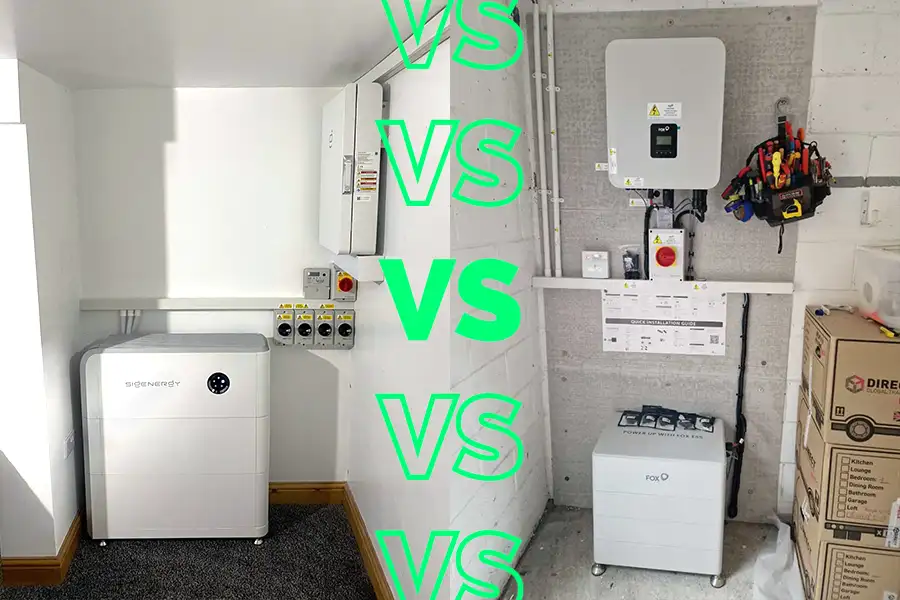
Sigenergy and Fox ESS solve the same problem in different ways: how a UK home should store and manage its solar energy. Sigenergy offers a premium, DC-coupled whole-home architecture with integrated EV charging, while Fox ESS offers a lower entry cost, a wider installer base, and a stronger track record on time-of-use tariffs. Both use lithium iron phosphate (LFP) chemistry, carry 10-year warranties, and require MCS-certified installation, so the decision comes down to your priorities, not which system is definitively better.
This comparison breaks down the key differences across inverters, batteries, efficiency, warranties, and real UK pricing so you can make the right call for your home.

19 min read
On this page
- Quick Verdict: Which System Should You Choose?
- Brand Background: Sigenergy and Fox ESS in the UK Market
- Inverters: Sigenergy vs Fox ESS
- Batteries: Sigenergy SigenStor vs Fox ESS
- Price: Is Sigenergy or Fox ESS Cheaper?
- Whole-Home Energy Integration: Ecosystem, EV Charging, and Backup Power
- Warranty and Long-Term Support: What Each Brand Actually Guarantees
- How Upvolt Helps You Choose Between Sigenergy and Fox ESS
- Let’s Recap
- About Upvolt
- FAQ
Key Takeaways
- Both Sigenergy and Fox ESS use lithium iron phosphate (LFP) battery chemistry and carry 10-year warranties, but what those warranties actually guarantee in terms of capacity retention and claim handling differs between the two brands and must be confirmed in writing before purchase.
- Sigenergy’s DC-coupled SigenStor energy system reduces energy conversion losses relative to AC-coupled Fox ESS configurations, a difference that compounds across thousands of cycles and directly affects long-term payback calculations.
- Fox ESS offers a lower entry cost and stronger compatibility with established UK smart tariffs, making it the more straightforward choice for homeowners prioritising faster payback without EV integration.
- Sigenergy’s integrated DC EV charging capability makes it the stronger option for homeowners planning to add an electric vehicle, but only where the system design, cable runs, and installer capability support that integration correctly from the outset.
Quick Verdict: Which System Should You Choose?
Fox ESS is the stronger choice for homeowners prioritising lower upfront cost and faster payback, particularly those on time-of-use tariffs. Sigenergy is the stronger choice for homeowners investing in a whole-home energy platform with DC EV charging and a longer technology horizon.
The single most important differentiating factor is system architecture. Sigenergy’s SigenStor uses a DC-coupled 5-in-1 design that reduces the number of energy conversion steps, so less energy is lost on each charge and discharge cycle. Fox ESS hybrid inverters, AC-coupled in most UK residential installations, add a conversion stage that marginally reduces round-trip efficiency. Over thousands of cycles across a 10-year battery life, that difference compounds into a meaningful payback variance.
Both systems require installation by MCS-certified installers for installations to qualify for Smart Export Guarantee (SEG) payments, the rate your energy supplier pays you for unused electricity sent back to the grid.
At a Glance
| Feature | Sigenergy SigenStor | Fox ESS Hybrid |
| Coupling type | DC-coupled | AC-coupled |
| Round-trip efficiency | ~93–95% (independent analysis) | ~90–95%, depending on metric cited |
| Battery capacity range | ~5–48kWh per stack | ~5–40+kWh |
| Cycle life | Confirm with installer | ~6,000 cycles (~16 years at one cycle/day) |
| Warranty | 10 years | 10 years |
| Capacity retention at term end | Confirm in writing | Confirm in writing |
| Indicative installed price | Premium above Fox ESS range | £3,500–£9,500 |
| DC EV charging | Native, built into the same unit | Via AC connection, adds a conversion step |
| Backup power (outage) | Available if configured for island mode | Available if configured for island mode |
| Confirmed smart tariff support | Tariff-aware software; confirm specific compatibility | Octopus Flux approved |
| UK market presence | Entered UK October 2023 | Longer-established UK installer base |
Note: Figures reflect independent analysis and published specifications current at the time of writing. Confirm exact specifications, warranty terms, and pricing with your installer before purchase.
Brand Background: Sigenergy and Fox ESS in the UK Market
About Sigenergy
Sigenergy was founded in 2022 by Tony Xu, formerly head of Huawei’s FusionSolar division. The company entered the UK market at Solar and Storage Live in October 2023, positioning the SigenStor energy system as an all-in-one alternative to conventional separate-component installations. Its pedigree in power electronics is strong, and the product architecture reflects genuine engineering ambition.
The honest implication of being a newer entrant is this: Sigenergy’s UK warranty claims infrastructure has a shorter track record than Fox ESS’s. Placing a 10-year product commitment with a brand that has been operating in the UK for under three years means less publicly available evidence about how claims are handled in practice.
That is not a reason to dismiss Sigenergy, but it is a factor worth weighing alongside the technical specification. However, we urge readers to verify that Sigenergy products hold current MCS product certification via the MCS product certificate database before purchase, as this status is required for SEG eligibility.
About Fox ESS
Fox ESS has been active in the UK market for longer and has established a broader installer base across southern England and beyond. That wider footprint matters for two practical reasons: more installers have commissioning experience with the system, and there is more publicly available evidence about how warranty claims are processed in the UK. For a 10-year product commitment, that track record is a genuine asset.
As a consumer, you should also confirm Fox ESS product certification status via the MCS product certificate database before proceeding, as certification must be current at the point of installation for Smart Export Guarantee eligibility criteria to apply.
Inverters: Sigenergy vs Fox ESS
The coupling architecture of a hybrid inverter determines how many times energy is converted between DC and AC before it reaches your appliances, and each conversion step loses a small percentage of energy. That is the core reason the Sigenergy versus Fox ESS inverter comparison matters beyond headline efficiency numbers.
Sigenergy Inverters
Sigenergy’s SigenStor uses a DC-coupled design. Solar panels generate DC electricity; the battery stores DC electricity; and in a DC-coupled system, energy moves between panels and battery without an AC conversion step in between. When you draw power from the battery, a single inversion step converts it to AC for household use.
According to published datasheets, the SigenStor achieves a system round-trip efficiency of approximately 93-95%%, though real-world performance will vary with installation conditions, ambient temperature, and load profile. The SigenStor covers 5–48kWh per stack, and its hybrid inverter output ranges from 3–12kW.
Fox ESS Inverters
Fox ESS hybrid inverters used in most UK residential configurations are AC-coupled, meaning solar generation is converted from DC to AC before any surplus is routed to the battery for storage, where it is converted back to DC, then converted again to AC when discharged. Each of those additional conversion steps carries a small loss.
Published figures for Fox ESS inverters vary depending on which metric is cited. Peak conversion efficiency reaches 97 to 97.6%, while independent analysis puts battery round-trip efficiency closer to 90 to 95%. So it’s worth asking your installer which figure any quote is actually referring to. Real-world performance depends on installation and usage conditions either way.
| Specification | Sigenergy SigenStor | Fox ESS Hybrid |
| Coupling type | DC-coupled | AC-coupled |
| Claimed round-trip efficiency | ~93-95%% (datasheet) | ~90 to 95% (datasheet) |
| Output power range | 3 to 12kW | 3.7 to 12kW |
| Battery chemistry | LFP | LFP |
The efficiency gap between the two systems is genuinely difficult to pin down from published figures alone, and may be as little as one percentage point depending on which metric each brand is citing. Even a small, consistent gap compounds across 3,000 cycles over a 10-year warranty period into a measurable difference in total energy recovered from storage.
Batteries: Sigenergy SigenStor vs Fox ESS
Every competitor article in this category states “10-year warranty” and moves on. That figure tells you the duration of the guarantee, not what it actually guarantees. The figures that matter to your financial case are the capacity retention threshold at the end of the term, the cycle count, and the conditions under which the warranty remains valid.
Sigenergy SigenStor Batteries
The SigenStor is a scalable modular battery system, with capacity configurable from approximately 5–48kWh per stack, a range that makes it suitable for homes with high storage requirements or plans to expand the system over time.
The depth of discharge (DoD) setting, how far the battery is drawn down before it stops discharging, determines how much of that nameplate capacity is usable in daily operation:
- A battery rated at 10kWh at 90% DoD delivers 9kWh of usable capacity per cycle
- The same battery at 80% DoD delivers 8kWh
This setting is applied during installation and should be confirmed with your installer.
Manufacturers typically warrant a minimum percentage of nameplate capacity at the end of the 10-year term, commonly in the range of 70–80%, though the specific threshold for Sigenergy should be confirmed from the manufacturer’s published warranty document before purchase. The battery management system (BMS) embedded in the SigenStor protects that warranty by monitoring:
- Cell temperature
- Voltage
- Charge state
Operating outside the BMS’s defined parameters, including exceeding temperature limits or using non-approved charge settings, can affect warranty validity.
Fox ESS Batteries: EP, EQ, and EVO Series
Fox ESS offers battery storage across three product lines:
- The EP Series covers lower-capacity residential installations
- The EQ Series steps up for mid-range requirements
- The EVO Series addresses higher-capacity applications
Total installed capacity across configurations can reach over 40kWh depending on system design.
The widely referenced 6,000-cycle life figure for Fox ESS batteries is worth contextualising: at one full charge/discharge cycle per day, 6,000 cycles represents approximately 16 years of operation, which exceeds the 10-year warranty period. That means the cycle limit is unlikely to be the binding constraint for most residential users. The binding commitment is the capacity retention threshold at the end of the warranty term, which should be confirmed in writing with your installer before signing a contract.
Fox ESS battery warranty conditions mirror the general industry pattern. Coverage typically remains valid only where:
- Installation is carried out by a certified installer
- The system operates within specified temperature ranges
- The product is registered within a defined window after installation
The battery management system (BMS) in Fox ESS units performs the same cell protection role as in Sigenergy systems. For further context on how battery storage works alongside solar generation, see our dedicated guide.
| Specification | Sigenergy SigenStor | Fox ESS (EP/EQ/EVO) |
| Capacity range | ~5 to 48kWh per stack | ~5 to 40+kWh |
| Battery chemistry | LFP | LFP |
| Cycle life | Confirm with installer | ~6,000 cycles |
| Warranty duration | 10 years | 10 years |
| Retention threshold | Confirm in writing | Confirm in writing |
Price: Is Sigenergy or Fox ESS Cheaper?
Fox ESS EP Series installations in the UK typically fall in the £3,500–£9,500 installed range, while Sigenergy SigenStor typically runs £5,500–£13,500, depending on battery capacity and system configuration. These are industry pricing observations based on published installer data rather than figures attributable to any specific installer.
That premium reflects what the SigenStor replaces, not just its own price tag:
- Its 5-in-1 integrated architecture
- Its DC-coupled efficiency design
- Its DC EV charging capability
A conventional installation needs a separate inverter, battery, and EV charger unit. Sigenergy consolidates those into one commissioning exercise, which reduces installation complexity and can lower the labour component of the total cost. For homeowners who aren’t planning to add an EV and don’t need the advanced integration features, that premium is harder to justify on a pure payback basis.
Payback period depends heavily on three things:
- Your daily consumption profile
- The proportion of solar generation you self-consume rather than export
- The electricity price at the time of installation
A home drawing 4,000kWh a year with a battery that lifts self-consumption from 30% to 70% will see a materially different payback timeline than a home drawing 2,000kWh with lower solar generation. Industry evidence suggests well-configured home battery storage systems typically pay back within 7–12 years, depending on usage patterns, system size, and electricity pricing, but that range is wide for a reason: a site assessment that models your specific consumption profile is the only reliable way to produce a payback figure that reflects your home rather than a sector average.
For a more detailed look at whether a solar battery is right for your specific situation, our guide on is a solar battery worth it for you covers the key financial thresholds.
Stay Connected with Upvolt
Get the latest updates on energy innovations, smart solutions, and exclusive offers.
Whole-Home Energy Integration: Ecosystem, EV Charging, and Backup Power
DC EV Charging: Sigenergy’s Integration Advantage
Sigenergy’s SigenStor integrates DC EV charging directly within the same unit as the inverter, battery, and grid connection. In a DC-coupled configuration, the EV draws power from the battery and solar without an additional AC conversion step.
In practice, this means slightly more of the energy your panels generate reaches your vehicle rather than being lost in conversion. For homeowners planning to add an EV charger alongside solar storage, this native integration is a genuine advantage over adding a separate AC-coupled EV charger later.
Fox ESS offers smart EV charging integration, but in most residential configurations this operates via an AC connection, adding one conversion stage relative to Sigenergy’s DC approach. That is a modest efficiency consideration rather than a fundamental limitation, and for homeowners who already own a separate smart charger, the Fox ESS route remains practical.
Backup Power During Grid Outages
Standard grid-tied solar systems shut down during grid outages due to anti-islanding protection requirements. This is a safety standard, not a design flaw: it prevents energy from flowing into a de-energised grid network and endangering engineers working on the lines. This applies to both Sigenergy and Fox ESS standard installations. Your solar panels do not continue generating usable power during an outage unless the inverter supports and has been configured for island mode operation.
Backup power capability depends entirely on whether your specific system has been configured to operate in island mode. Both Sigenergy and Fox ESS offer products that can support island mode, but this is a configuration that must be specified before installation and commissioned correctly.
If backup power is a priority for your home, confirm with your installer that the selected inverter and battery configuration supports island mode, and that it will be set up that way, before the system is specified.
App Monitoring and Smart Tariff Compatibility
Both Sigenergy and Fox ESS provide app-based monitoring covering real-time generation, consumption, battery state, and grid import/export. In our experience, the quality of app data is one of the more practically useful features for homeowners adjusting their usage habits after installation: being able to see when generation is high and when battery charge is available changes how people run appliances and when they charge vehicles.
Fox ESS has confirmed compatibility with Octopus Flux, the time-of-use tariff that rewards homeowners for charging their battery at low-rate overnight periods and exporting or self-consuming during peak periods. For readers already on or planning to move to Octopus Flux, this is a meaningful practical advantage.
Sigenergy’s energy management software supports tariff-aware charging, though compatibility with specific UK smart tariff platforms should be confirmed with your installer before purchase. Where whole-home energy optimisation across multiple devices is a priority, the Skygate® home energy management system integrates solar, battery, EV, and heat pump into a single platform.
Warranty and Long-Term Support: What Each Brand Actually Guarantees
Both brands offer 10-year product warranties, but the headline figure doesn’t resolve the question of what you’re actually protected against. The commitment that matters most to your financial case is the capacity retention threshold: the minimum percentage of nameplate battery capacity the manufacturer warrants will remain at the end of the 10-year term. Manufacturers typically warrant retention in the range of 70–80% of original capacity, but the specific figure for each brand must be confirmed from the published warranty document, not taken on trust from a sales conversation.
Conditions that can void coverage are material and often overlooked. Coverage typically depends on:
- Installation by an MCS-certified installer
- Operating the system within specified ambient temperature ranges
- Configuring grid export settings within inverter limits
- Registering the product within the required post-installation window
These are not obscure small-print traps; they are standard industry conditions that reflect the operational parameters within which the battery management system is designed to maintain cell health.
For UK buyers, the practical warranty question is also who processes a claim. Fox ESS’s longer UK operating history means there’s more publicly available evidence of how its warranty claims are handled in practice, which in-country distributor is involved, and how quickly replacement units or remedial work is arranged. Sigenergy’s UK claims infrastructure is newer, and that shorter track record is a legitimate consideration when placing a 10-year commitment.
Requesting the full warranty document before purchase and asking your installer which specific entity is named as the warrantor is the most important step any prospective buyer can take. For a broader look at how solar panels and battery storage work together as a system, our dedicated guide covers the full financial and technical picture.
How Upvolt Helps You Choose Between Sigenergy and Fox ESS
Choosing between two technically credible systems on the basis of published specifications alone is an unreliable approach. What determines the right answer for your home is the interaction between your specific consumption profile, your existing solar array if retrofitting, your EV plans, and your tariff structure.
System Design and Site Assessment
Upvolt’s MCS-certified operating companies install both Sigenergy and Fox ESS systems, which means the recommendation a customer receives is not shaped by a preference for one brand over the other. Before recommending either system, we evaluate your existing solar array compatibility, your daily consumption profile and when demand peaks, your current or planned EV ownership, your tariff type, and any property constraints that affect cable routing or installation access. That assessment is what converts a general comparison into a specific, defensible recommendation for your home.
Installation and Commissioning
Correct installation and commissioning of either system is what protects your Smart Export Guarantee eligibility and your warranty coverage. Both systems require installation by an MCS-certified operating entity: for Upvolt, that means Upvolt Oxfordshire Ltd, OHM Energy Ltd, or Deege Ltd depending on your location. Commissioning includes verifying that battery DoD settings, temperature thresholds, and grid export limits are configured within the manufacturer’s specified parameters. Getting those parameters right at the point of installation matters because deviations are among the most common reasons warranty coverage is later questioned.
Ongoing Monitoring and Support
Both Sigenergy and Fox ESS provide app-based monitoring that makes it straightforward to track system performance after installation. Where a customer wants to integrate their battery system with additional devices, such as a heat pump or a smart EV charger, Upvolt’s Skygate® home energy management system brings those devices into a single energy management platform.
Let’s Recap
Fox ESS is the stronger starting point if lower upfront cost, faster payback, and compatibility with tariffs like Octopus Flux matter most to you. Sigenergy is the stronger investment if you want a whole-home platform integrating solar, storage, DC EV charging, and advanced energy management under one system. Neither is wrong; it depends on your priorities.
The 10-year warranty both brands carry is a starting point, not a conclusion. What matters is the capacity retention guaranteed at the end of that term, the conditions that keep coverage valid, and who actually handles a UK claim. Get the warranty document in writing and confirm the named warrantor before you sign.
Efficiency and degradation rate drive long-term payback more than most installer comparisons let on, yet published figures for both brands are harder to pin down than the headline percentages suggest. Ask your installer which specific metric any quoted figure represents before comparing the two systems on efficiency alone.
Fox ESS typically runs £3,500–£9,500 installed, Sigenergy £5,500–£13,500, both depending on capacity and configuration. This comparison tells you which system suits which buyer; a site assessment modelling your consumption, tariff, and EV plans tells you which one suits your home.
About Upvolt
Upvolt is a renewable energy installer whose MCS-certified operating companies install both Sigenergy and Fox ESS home battery storage systems across southern England, alongside solar panels, EV chargers, heat pumps, and the Skygate® home energy management system. The range of products Upvolt installs means that a customer decision between Sigenergy and Fox ESS is evaluated on its merits for that home, not on a commercial preference for one brand.
Upvolt’s installer experience with both systems means the advice a customer receives is grounded in real commissioning decisions, not a spec-sheet comparison. That includes which system performs better in the retrofit scenarios common across southern England’s housing stock, what installation constraints tend to favour one architecture over the other, and how each system’s commissioning requirements translate into real-world configuration outcomes.
Picking the wrong system for your home doesn’t show up as a mistake on day one, it shows up as a slower payback for the next ten years. Upvolt can run the numbers against your actual consumption, tariff, and any EV plans, so you’re choosing based on your home rather than a general comparison, starting with a get a free, no-obligation quote.
FAQ
Is Sigenergy Better Than Fox ESS for Home Solar Battery Storage?
Neither system is categorically better. Fox ESS offers a lower upfront cost and faster payback, particularly for homeowners on time-of-use tariffs, while Sigenergy’s DC-coupled SigenStor is the stronger option for homeowners who want integrated DC EV charging and a whole-home energy platform. Both use LFP battery chemistry, carry 10-year warranties, and are available through MCS-certified installers. A site assessment is the most reliable way to identify which system suits your specific home and usage pattern.
What Battery Capacity Range Do Sigenergy and Fox ESS Offer?
Sigenergy’s SigenStor is configurable from approximately 5kWh to 48kWh per stack, making it suitable for homes with high storage requirements or expansion plans. Fox ESS covers a similar range across its EP, EQ, and EVO product lines, with total installed capacity potentially exceeding 40kWh depending on configuration. Usable capacity in practice depends on the depth of discharge setting applied during installation. The right capacity for your home depends on your daily consumption profile and how much usage you want to shift to stored solar energy.
Does Fox ESS or Sigenergy Provide Better Backup Power During a Grid Outage?
Backup power capability depends on whether your specific system is configured for island mode operation. Standard grid-tied solar and battery systems shut down during grid outages due to anti-islanding protection requirements, which prevent the system from feeding electricity into a de-energised network. Both Sigenergy and Fox ESS offer products that can support island mode, but this must be specified before installation and confirmed as correctly commissioned. If backup power is a priority, raise this requirement explicitly with your installer before the system is designed.
Which Has a Longer Warranty: Sigenergy or Fox ESS?
Both brands offer 10-year product warranties on their battery storage systems. The more important question is the capacity retention threshold warranted at the end of the term and the conditions that must be met for the warranty to remain valid. Sigenergy’s UK warranty claims infrastructure is newer than Fox ESS’s, which is a practical consideration for a 10-year commitment. Request the full warranty document from your installer before purchase and confirm which entity is named as the warrantor.
Are Sigenergy and Fox ESS Compatible With Existing Solar Panel Systems?
Both systems can be retrofitted to existing solar installations in most cases, though compatibility depends on the existing inverter type, array size, and original commissioning setup. Sigenergy’s SigenStor is designed as an all-in-one replacement for the inverter and battery, which may require replacing a functioning existing inverter and should be factored into any payback calculation. Fox ESS hybrid inverters can in some configurations integrate alongside existing equipment, though this varies by setup. A site survey is required to confirm compatibility before either system is specified for a retrofit installation.

Alex Lomax
CEO & Co-Founder
Share article


Share article