-
Now live! Generate even more savings with our Skygate system. Click here to learn more.

On this page
- How Solar Panels Convert Sunlight into Electricity
- The Three Main Types of Solar Panel
- Monocrystalline Solar Panels
- Polycrystalline Solar Panels
- Thin-Film Solar Panels
- Beyond the Main Three: Bifacial, Solar Tiles, and Emerging Technologies
- Which Type of Solar Panel Is Right for Your Home?
- How Upvolt Selects and Installs the Right Solar Panel Type
- Let's Recap
- About Upvolt
- FAQ
Renewable Energy Hardware
16 mins read
What Are the Different Types of Solar Panels?
3 Aug 2026Review the different types of solar panels and evaluate quotes with confidence.
Take the first step toward energy independence today.
get a quote
On this page
- How Solar Panels Convert Sunlight into Electricity
- The Three Main Types of Solar Panel
- Monocrystalline Solar Panels
- Polycrystalline Solar Panels
- Thin-Film Solar Panels
- Beyond the Main Three: Bifacial, Solar Tiles, and Emerging Technologies
- Which Type of Solar Panel Is Right for Your Home?
- How Upvolt Selects and Installs the Right Solar Panel Type
- Let's Recap
- About Upvolt
- FAQ
Not all solar panels work the same way, and the type of panel fitted to your roof directly affects how much electricity your system generates, how many panels you need, and what you pay. There are three primary panel types in common use, plus a growing range of specialised formats for specific installation contexts.
The industry has largely settled on one type for UK residential installations, and understanding why requires looking beyond the basic mono/poly/thin-film label. This guide explains each type, the cell architectures that determine real-world performance, and which option is most likely to suit your home.

17 min read
On this page
- How Solar Panels Convert Sunlight into Electricity
- The Three Main Types of Solar Panel
- Monocrystalline Solar Panels
- Polycrystalline Solar Panels
- Thin-Film Solar Panels
- Beyond the Main Three: Bifacial, Solar Tiles, and Emerging Technologies
- Which Type of Solar Panel Is Right for Your Home?
- How Upvolt Selects and Installs the Right Solar Panel Type
- Let’s Recap
- About Upvolt
- FAQ
Key Takeaways
- Monocrystalline panels are the standard for UK residential installations, delivering typically 20 to 23% efficiency per square metre, which matters most where roof space is limited.
- Polycrystalline panels are less efficient and increasingly difficult to source from reputable UK installers, because the cost advantage that once justified them has largely disappeared as monocrystalline prices have fallen.
- Thin-film panels suit non-standard surfaces, curved roofs, and some large commercial flat-roof scenarios, but their lower efficiency means they need significantly more surface area to match the output of a crystalline system.
- Within monocrystalline, cell architecture (PERC, TOPCon, or HJT) is the real driver of efficiency and price differences between quotes, and understanding this helps you evaluate competing proposals on a like-for-like basis.
How Solar Panels Convert Sunlight into Electricity
Solar panels generate electricity through the photovoltaic effect, a process in which photons from sunlight are absorbed by silicon cells, causing electrons to move and producing a direct electrical current. This is worth understanding in more detail in our guide to how solar panels work, but the core principle is straightforward: sunlight in, electricity out.
The current produced is direct current (DC), which flows in one direction only, like a battery. An inverter converts this into alternating current (AC), the form of electricity used by every appliance in your home.
The purity and internal structure of the silicon in each cell determines how efficiently that conversion happens, which is the underlying reason different solar panel types exist at all.
What Is a Photovoltaic Cell?
A solar panel is made up of many individual photovoltaic (PV) cells arranged in a grid. Each cell is a thin layer of semiconductor material, usually silicon, that absorbs light and releases electrons. The number of cells affects the panel’s physical size, but it does not automatically determine its output. What matters is the quality and efficiency of those cells. A panel with fewer, higher-quality cells can easily outperform one with more cells of lower quality.
The Three Main Types of Solar Panel
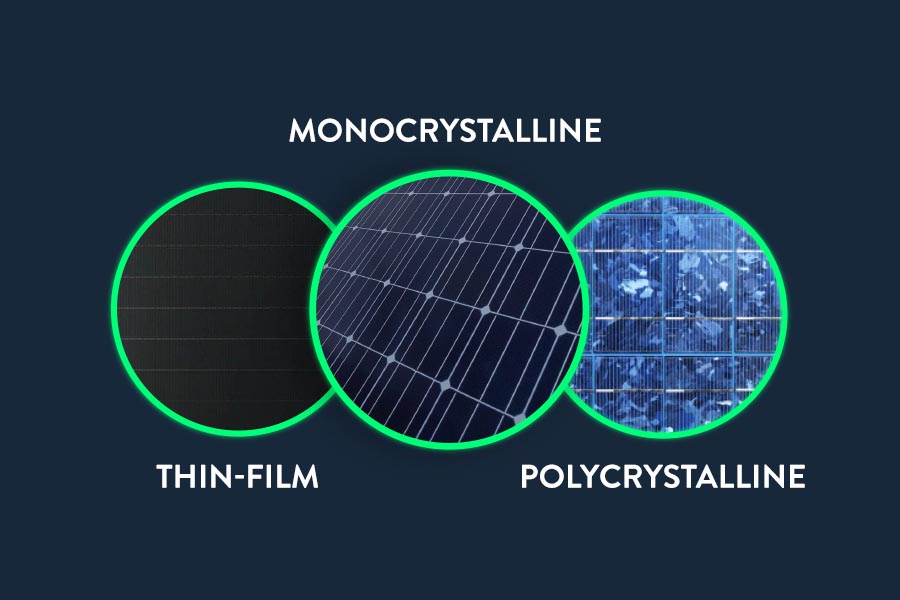
The main types of solar panels available for UK properties fall into three categories. Monocrystalline is the standard for residential installations. Polycrystalline is declining in availability and relevance. Thin-film occupies a specific niche for non-standard surfaces and some commercial applications.
At a Glance: The Three Main Types of Solar Panel
| Type | Efficiency Range | Appearance | Best Use Case | Relative Cost |
| Monocrystalline | 20 to 23%+ | Uniform black or dark blue | Most UK residential roofs | Higher upfront, falling |
| Polycrystalline | 15 to 17% | Speckled blue | Limited; rarely recommended for new installs | Lower, but advantage is narrowing |
| Thin-film | 10 to 13% | Uniform, can be flexible | Curved surfaces, large commercial flat roofs | Lower per panel, but more panels needed for equivalent output |
Within the monocrystalline category, cell architecture adds a further layer of variation. PERC, TOPCon, and HJT cells all use the same monocrystalline silicon substrate but differ in how efficiently they convert light to electricity. This distinction, covered in detail below, is often what separates two monocrystalline quotes at different price points.
Monocrystalline Solar Panels
Monocrystalline solar panels are made from a single, continuous silicon crystal grown using the Czochralski process. A cylindrical silicon ingot is drawn from molten silicon, then sliced into wafers. Because every wafer comes from one unbroken crystal, the internal structure is highly ordered. Electrons move through it more freely, and more of the light that reaches the cell becomes usable electricity.
The characteristic appearance is a uniform dark or near-black finish with slightly rounded cell corners, which gives monocrystalline panels their distinctive look compared to the speckled blue of polycrystalline. Efficiency typically sits between 20 to 23% for mainstream panels, with premium models exceeding that.
Lifespan is generally 25 to 30 years, and most panels carry a performance warranty guaranteeing output above a specified level for most of that period. For a more detailed look at what these figures mean in practice, see our guide to solar panel efficiency.
Why Monocrystalline Panels Are the UK Residential Standard
Higher efficiency means fewer panels are needed to reach the same system output. For the typical UK semi-detached or terraced property, where usable roof area is limited, this is a practical advantage rather than a theoretical one. A smaller panel count also means fewer roof penetrations and a tidier installation.
The dark, uniform appearance also tends to satisfy planning authority preferences more readily than the blue, speckled finish of polycrystalline panels, particularly in areas with design guidelines. As monocrystalline prices have fallen significantly over the past decade, the cost premium over polycrystalline has narrowed to the point where the efficiency advantage now justifies the price in almost every residential scenario.
Cell Architecture Within Monocrystalline: PERC, TOPCon, and HJT
“Monocrystalline” describes the silicon substrate, not the cell design. Two panels can both be monocrystalline and differ meaningfully in performance because of their cell architecture.
- PERC (Passivated Emitter and Rear Cell) adds a reflective layer to the rear of the cell. Light that passes through the silicon without being absorbed is bounced back for a second pass, increasing the proportion that generates electricity. PERC became the mainstream residential standard in the UK through the 2010s.
- TOPCon (Tunnel Oxide Passivated Contact) goes further. It reduces electron recombination losses at the cell surface, where energy is otherwise lost as heat before it becomes current. TOPCon panels typically achieve higher efficiency than PERC at a modest price premium. They are now the mainstream premium standard in new residential installations.
- HJT (Heterojunction) combines a crystalline silicon layer with thin-film amorphous silicon layers on each side. This structure achieves some of the highest efficiencies available and also performs better at elevated temperatures. HJT panels tend to carry the highest price among the three.
- The practical implication is direct. If you receive two monocrystalline quotes at different prices, the difference often reflects different cell architectures. Asking the installer which architecture the quoted panel uses gives you a basis for comparing proposals properly, not just on headline cost.
Polycrystalline Solar Panels
Polycrystalline panels are made by melting multiple silicon fragments together and pouring them into a square mould. This is a simpler, less energy-intensive process than growing a single crystal, which is why polycrystalline panels were cheaper to produce and, for many years, widely used in residential installations.
- The resulting structure is less ordered than monocrystalline silicon.
- Crystal boundaries form throughout the material, interrupting the movement of electrons.
- The result is a panel that’s less efficient, typically 15 to 17%, requiring more surface area to match a monocrystalline system’s output.
- The speckled blue appearance, caused by light reflecting differently across multiple crystal orientations, is visually distinct and often considered less attractive by homeowners and planning authorities alike.
The cost gap that once made polycrystalline attractive has narrowed considerably. Monocrystalline manufacturing costs have fallen significantly over the past decade, and most reputable UK installers have shifted their supply chains accordingly. For most UK homes, the efficiency penalty of polycrystalline no longer comes with a proportionate saving.
A site with limited roof space is particularly poorly served by a less efficient panel type. Polycrystalline panels aren’t unreliable, existing installations continue to generate electricity, but for new residential installations today, they’re rarely the right starting point.
Thin-Film Solar Panels
Thin-film solar panels are made by depositing a photovoltaic material in a thin layer onto a substrate, which can be glass, metal, or a flexible material. The photovoltaic materials used include cadmium telluride (CdTe), amorphous silicon (a-Si), and copper indium gallium selenide (CIGS). This manufacturing process produces panels that are lighter, more flexible, and capable of conforming to surfaces where rigid panels cannot be fitted.
The trade-off is efficiency. Commercial thin-film panels typically achieve 10 to 13%, significantly lower than crystalline silicon panels. A thin-film system needs substantially more surface area to match the output of a monocrystalline system of equivalent wattage.
For a standard UK residential pitched roof, where available area is usually the binding constraint, this makes thin-film a poor fit for most homeowners.
When Does Thin-Film Make Sense for UK Properties?
Thin-film becomes a practical choice in specific scenarios. Large commercial flat roofs with ample surface area can accommodate the additional panel count required, and the lower weight of thin-film panels reduces structural loading, which matters on older buildings where adding heavy equipment is a concern. Curved or irregular roof structures that cannot accept rigid framing are another context where thin-film flexibility is genuinely useful. Mobile homes, caravans, and boats also benefit from the lightweight, flexible format.
For businesses evaluating this option across a large flat-roof site, our residential solar panels pages cover the core system considerations, with commercial design discussed separately. For the vast majority of UK residential pitched roofs, thin-film is not the recommended panel type, and a reputable installer will not normally propose it unless the property has a clear structural or surface reason.
Beyond the Main Three: Bifacial, Solar Tiles, and Emerging Technologies
Several additional panel formats appear in the market and in online research. Each serves a specific use case, and understanding what they are prevents confusion when they appear in quotes or comparisons.
Bifacial Solar Panels
Bifacial panels generate electricity from both the front and rear surfaces. The rear captures light reflected from surfaces below or around the panel, such as a pale membrane on a flat roof or light-coloured ground on a ground-mount installation. In the right conditions, this can increase yield by a meaningful margin.
For standard residential pitched roofs, the rear of the panel faces the roof surface directly, with no significant reflected light available. The bifacial advantage disappears in this configuration, and the additional cost is rarely justified. Ground-mount systems and commercial flat-roof installations with high-albedo surfaces are where bifacial solar panels genuinely add value.
Solar Roof Tiles
Solar roof tiles embed photovoltaic cells into roofing tiles designed to integrate visually into the roof structure. The result is a system with no visible panel frames, which suits properties where appearance is the primary constraint, including conservation areas, listed buildings, and premium new builds.
The trade-offs are significant. Solar tiles carry a substantial cost premium over standard panel installations, and they generate less electricity per square metre than equivalent panel systems. For a homeowner whose overriding concern is aesthetics, they are a valid option. For a homeowner primarily focused on financial return, the efficiency penalty and cost premium make them harder to justify.
We’ve compared this in detail in our solar roof tiles vs solar panels article.
Perovskite and Next-Generation Technologies
Perovskite cells have shown promising efficiency gains in laboratory settings, with some research results significantly exceeding current commercial crystalline panel benchmarks. They are not yet commercially available as a mainstream residential product in the UK.
Manufacturing consistency, long-term degradation behaviour, and weatherproofing at scale are areas where further development is ongoing. Perovskite is worth monitoring, but it is not a practical consideration for a homeowner making a decision today.
Which Type of Solar Panel Is Right for Your Home?
The right solar panel type depends on four practical variables: available roof space, budget, aesthetics, and the nature of the installation surface.
- Limited roof space (typical of UK terraced and semi-detached homes): monocrystalline panels with TOPCon or HJT cell architecture deliver the most generation per square metre, this is where the efficiency premium earns its cost most clearly.
- Abundant roof space with budget as the main constraint: a larger polycrystalline system could theoretically match a smaller monocrystalline one’s output, though the narrowing cost gap makes this less favourable to polycrystalline than it was five years ago.
- Appearance as the overriding concern, particularly on a listed building or in a conservation area: solar tiles merit serious consideration despite their efficiency and cost trade-offs.
- Non-standard, curved, or structurally weight-sensitive surfaces: thin-film becomes relevant regardless of the efficiency penalty.
One detail worth raising at the quote stage: TOPCon and HJT panels use an N-type silicon base, while standard PERC panels use a P-type base. N-type cells tend to degrade more slowly and perform slightly better in high temperatures. For most homeowners this is a secondary consideration, but if an installer quotes multiple monocrystalline options at different prices, asking about cell type helps clarify exactly what you’re comparing.
The most reliable way to determine which panel type suits a specific roof is a site assessment that accounts for orientation, shading, available area, and any planning constraints.
Stay Connected with Upvolt
Get the latest updates on energy innovations, smart solutions, and exclusive offers.
How Upvolt Selects and Installs the Right Solar Panel Type
Panel selection begins with what the roof actually allows. Orientation, pitch, shading from nearby structures or trees, available surface area, and any local planning constraints all determine which panel type and cell architecture will deliver the strongest output for a given property.
Roof Assessment and Panel Type Selection
Upvolt’s assessment process evaluates each of these factors before any system is designed. In most of the homes we survey, roof space is the binding variable, which is why we install high-efficiency monocrystalline panels as standard. Their performance in the UK’s moderate solar irradiance conditions, combined with their declining cost premium, makes them the practical choice for the vast majority of residential properties across southern England.
Where planning constraints apply, such as a conservation area designation or a listed building, the assessment also identifies whether solar tiles are a viable alternative and what the output trade-off would be compared to a standard panel installation.
Installation and System Design
System design varies with the panel type selected. TOPCon and HJT panels have different electrical characteristics to standard PERC panels, and the inverter configuration, string layout, and cabling design are all specified around the chosen panel. Where battery storage is being added alongside the solar installation, system design accounts for inverter compatibility and how the battery will interact with the panel array during generation peaks and overnight discharge.
Monitoring Performance with Skygate®
Upvolt’s proprietary Skygate® home energy management system integrates with the installed solar panels to track generation and self-consumption in real time. Homeowners can see exactly how much electricity their panels are producing, how much of that is being used directly in the home, and how much is being exported to the grid. This visibility allows usage patterns to be adjusted around generation peaks, improving overall self-consumption without any manual calculation.
Upvolt’s MCS-certified operating companies meet the standard required for Smart Export Guarantee (SEG) eligibility, meaning installations qualify for export payments where applicable. SEG is the scheme through which energy suppliers pay you for unused electricity your panels send back to the grid.
MCS certification is a legal requirement for SEG eligibility, not a differentiator. The MCS product register lists all certified panel products and installation companies whose work qualifies for the scheme.
Let’s Recap
The different types of solar panels available in the UK differ primarily in silicon structure, which drives their efficiency, appearance, cost, and best use. Monocrystalline has become the dominant residential choice, delivering the highest output per square metre, and its cost premium over polycrystalline has narrowed enough that it’s rarely a meaningful trade-off today.
Within monocrystalline, cell architecture is the real differentiator between quotes. PERC, TOPCon, and HJT all use the same substrate but vary in efficiency and price, understanding this lets you evaluate proposals properly rather than comparing headline panel counts alone.
Thin-film, bifacial, and solar tiles each serve specific cases: thin-film for non-standard or weight-sensitive surfaces, bifacial for ground-mount and commercial flat roofs with reflected light, solar tiles for aesthetics-first scenarios. Perovskite and other emerging technologies aren’t yet commercially available in the UK as mainstream residential products.
The right panel type depends on roof geometry, available space, planning constraints, and budget, all of which vary property to property. That’s why a site assessment beats any general guide.
About Upvolt
Upvolt is a renewable energy installer serving homeowners across southern England, specialising in solar panels, battery storage, heat pumps, EV chargers, and the Skygate® home energy management system. Upvolt installs high-efficiency monocrystalline panels selected for their performance in UK solar conditions, with system design built around each customer’s specific roof, usage pattern, and energy goals.
Upvolt’s MCS-certified operating companies meet the certification standard required for Smart Export Guarantee eligibility. This means installations completed by Upvolt qualify for SEG export payments where the customer’s tariff and panel system meet the scheme’s conditions.
Curious what a system built around your roof, usage, and panel choice would actually generate, save, and cost? Get a free, no-obligation quote and Upvolt will give you the real numbers for your specific property, no pressure, just clarity before you decide.
FAQ
Is Monocrystalline Always the Best Type of Solar Panel for a UK Home?
For most UK residential rooftop installations, monocrystalline panels are the most practical choice because they deliver the highest electricity output per square metre. Where roof space is limited, the efficiency advantage translates directly into more generation from the available area. For non-standard installations, curved roofs, or large commercial flat roofs, other panel types may be more appropriate, and a site-specific assessment is the reliable way to confirm which type suits a given property.
What Is the Difference Between PERC, TOPCon, and HJT Solar Panels?
All three are cell architectures used within monocrystalline panels. PERC adds a rear reflective layer to improve light capture. TOPCon reduces energy loss at the cell surface and is currently the mainstream premium standard in residential installations. HJT combines crystalline and thin-film layers to achieve some of the highest efficiencies available, with better performance in high temperatures. If two monocrystalline quotes differ in price, the difference often reflects different cell architectures, and asking the installer which architecture is being quoted allows a meaningful comparison.
Are Polycrystalline Solar Panels Still Available in the UK?
Polycrystalline panels are technically still manufactured and available, but most reputable UK installers have shifted their supply chains toward monocrystalline as prices have fallen and efficiency advantages have widened. For a homeowner starting a new installation today, it is unlikely that a reputable installer will recommend polycrystalline unless there is a specific reason related to that property.
Can I Mix Different Types of Solar Panels on the Same Roof?
Mixing panel types on the same roof is technically possible but generally unsuitable for standard string inverter installations. A string system regulates output to match the lowest-performing panel, so mixing monocrystalline and thin-film panels would limit the output of the higher-performing panels. Where mixing is genuinely necessary, a microinverter or DC optimiser setup can isolate performance by panel. In most residential scenarios, a uniform panel type and model across the entire system delivers the simplest installation and the most predictable output.
Do Solar Tiles Count as Solar Panels for MCS Certification and the Smart Export Guarantee?
Solar tiles that generate electricity through the photovoltaic effect are classified as PV systems and are subject to the same MCS certification requirements as conventional panel installations. The installer must hold MCS certification through their operating entity, and the tile product itself must be listed on the MCS product register. Not all solar tile products on the UK market carry MCS product listing, which means a tile that is not on the register cannot form part of a certified installation. Confirming MCS product eligibility before purchasing solar tiles is an important step for any homeowner for whom SEG income forms part of the financial case.

Alex Lomax
CEO & Co-Founder
Share article


Share article