Where can you store a solar battery in the UK?
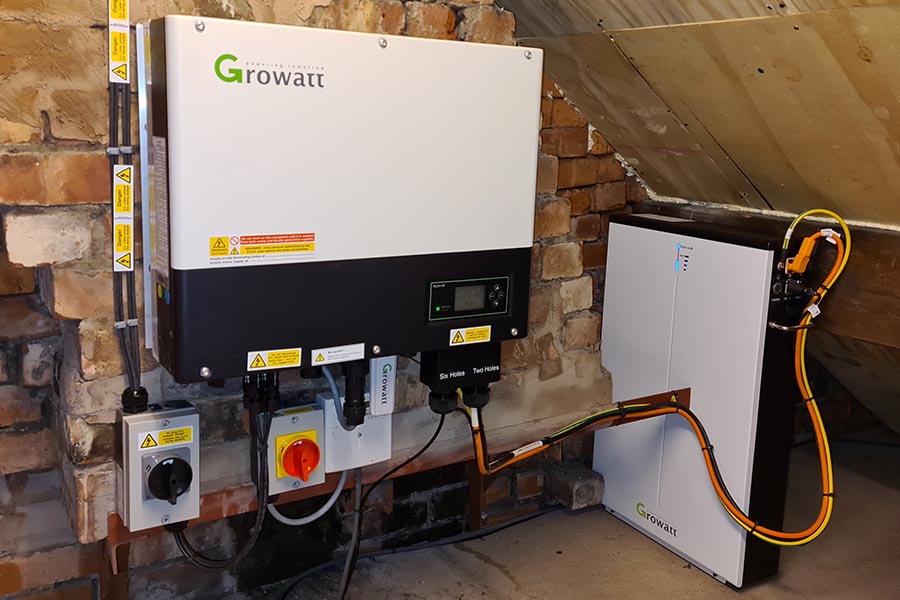
If you’re planning battery storage, the honest answer used to be “pretty much anywhere.” That’s no longer true. New UK fire safety guidance, published in 2024, rules out several locations that were common practice a few years ago, including lofts.
Here’s what’s actually allowed in 2026, and why the rules changed.
The short answer
- Outdoors is now the preferred location, where there’s space for it.
- Garages and utility rooms are usually fine, with the right fire separation.
- Lofts, bedrooms and cupboards opening into bedrooms are excluded.
- Most installs don’t need planning permission, but a few situations do.
The detail below covers what applies to your home.
Why the rules changed
Battery fires are rare, but lithium-ion batteries burn differently to most house fires: intensely, quickly, and in a way that’s hard for firefighters to approach safely. A battery installed somewhere with no easy escape route, or above someone’s head in a loft, turns a rare event into a serious one.
In March 2024, the British Standards Institution published PAS 63100, the first UK-wide guidance on where domestic battery storage can safely go. It’s not yet a legal requirement, but MCS-certified installers, insurers and mortgage lenders are already treating it as the benchmark. If your battery is sitting somewhere the guidance now excludes, it’s worth asking your installer about relocating it.
Where you can install a solar battery
Outdoors, where practical. PAS 63100 recommends outdoor installation as the first choice: a wall-mounted or ground-mounted battery in a suitable weatherproof enclosure, kept clear of doors, windows, vents and escape routes.
Garages. Both attached and detached garages are generally fine, provided there’s proper fire separation between the garage and the rest of the house. If the garage is also used for car parking, the battery needs protection from impact.
Utility rooms and similar indoor spaces, away from bedrooms and escape routes, subject to the exclusions below.
- Accessibility. Your installer needs to fit the battery in, and get back to it for servicing later.
- Room to grow. Most batteries can be added to if you want more storage down the line. Leave space if that’s likely
- Cable run. Batteries sit close to the inverter to minimise voltage loss, so location affects cable length and, sometimes, cost.
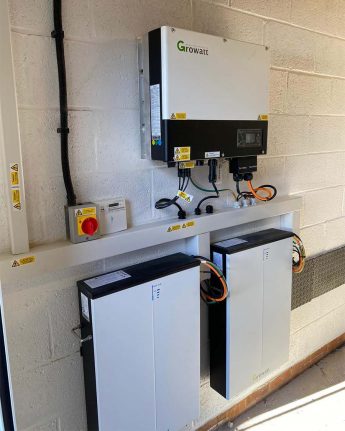
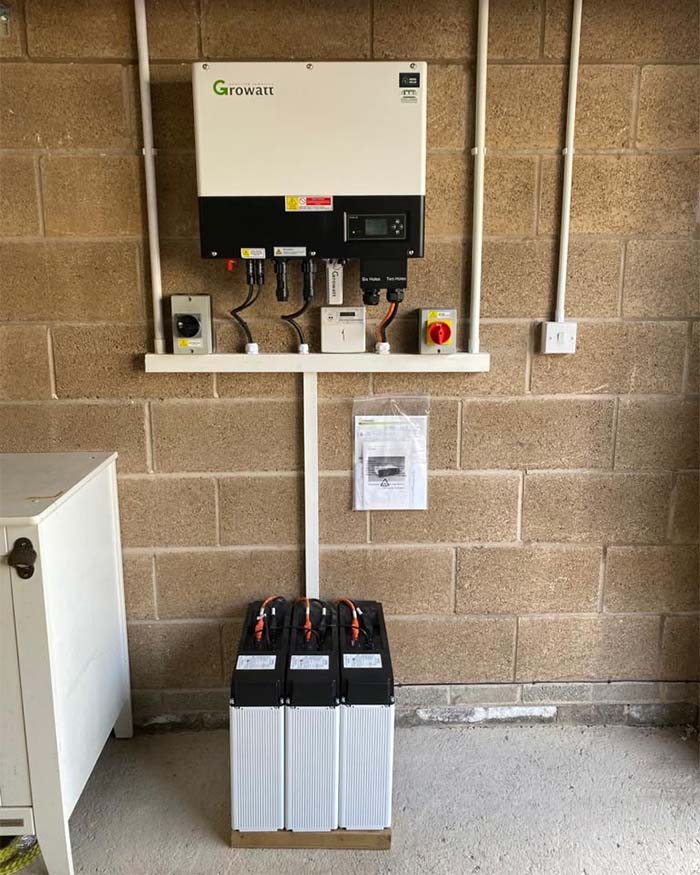
Here are two examples of a typical Garage Solar battery installation. As you can see the solar batteries are always installed together with the solar inverter and can either be mounted directly onto the wall, or sit simply on the ground. The first picture shows an installation of two wall mounted 6.5kWh Growatt batteries, the second shows three stacked 3.3kWh Growatt batteries. The batteries should always be located near to their inverter/controller (especially with a DC coupled system), to minimise voltage loss in transferring current between the two.
Where you can't install a solar battery
Under PAS 63100, batteries must not go in:
| Excluded location | Why |
|---|
| Bedrooms or any room people sleep in | Fire risk directly above or near a sleeping occupant |
| Lofts, roof spaces or voids | Risk of a heavy battery (often 40–100kg) falling through a burning floor |
| Unprotected escape routes (hallways, landings, staircases) | Blocks the way out in a fire |
| Protected escape route corridors, stairs or lobbies | Same reason, higher-risk locations |
| Cupboards or enclosures opening into a bedroom | Same fire risk as the bedroom itself |
| Cellars or basements with no access to the outside | No safe means of escape or ventilation |
| Outdoors, within 1m of doors, windows, vents or escape routes | Fire and smoke risk to the building |
| Within 2m of flammable materials or fuel storage | Increases fire spread risk |
If your current setup, or a location you’re considering, falls into one of these, talk to your installer about alternatives before going ahead.
Can a solar battery go outside?
Yes, and increasingly this is the recommended approach. Battery datasheets state whether a product is rated for outdoor use, usually via an IP (Ingress Protection) rating. In plain terms: the higher the number, the more protection against water and dust. For an outdoor installation with no additional shelter, look for IP65 or higher. Given how much the UK rains, indoor installation (in a suitable location) or a simple sheltered enclosure outdoors is usually the safer bet either way.
Do I need planning permission for a solar battery?
For most homeowners, no. Domestic battery storage installed alongside a solar PV system is generally covered under permitted development rights, meaning you won’t need to apply for planning permission.
There are exceptions:
- Flats and maisonettes don’t have permitted development rights at all, so any external installation needs planning permission.
- Listed buildings need listed building consent for external alterations, regardless of permitted development rights.
- Conservation areas and properties covered by an Article 4 Direction can have tighter local restrictions.
If any of these apply to you, check with your local planning authority before installing. Your installer should be able to flag this during your site survey.
What does a solar battery installation cost?
Cost depends on your setup. If you already have solar panels and are adding a battery, that’s a retrofit, which needs a controller to manage energy flow between the two and typically costs more than installing solar and battery storage together from the start. Some systems combine the inverter and battery in one hybrid unit, which can simplify things.
The best way to get an accurate figure is a quote based on your home, your existing setup (if any), and where the battery will go.
Let’s Recap
Since 2021, the rules on where you can safely install a solar battery have changed. In March 2024, the British Standards Institution published PAS 63100, the first UK-wide fire safety guidance on battery placement. It’s not yet a legal requirement, but MCS-certified installers, insurers and mortgage lenders are already treating it as the standard, which means older advice, including “anywhere is fine”, no longer holds.
The headline change is that outdoor installation is now the preferred option where practical, and several previously common indoor locations, most notably lofts, bedrooms, cupboards opening into bedrooms, and unprotected escape routes, are explicitly excluded. Garages remain a solid option provided there’s proper fire separation from the rest of the house.
For most homeowners, planning permission still isn’t needed, since domestic battery storage is generally covered under permitted development rights. The exceptions are flats and maisonettes, listed buildings, and some conservation areas, so it’s worth checking if any of those apply to your property before you go ahead.
About Upvolt
Upvolt is a renewable energy installer serving homeowners and businesses across southern England and the Home Counties, specialising in rooftop solar panels, home battery storage, heat pumps, EV chargers, and the Skygate® home energy management system. Upvolt’s MCS-certified operating companies carry out installations designed around current safety standards, including PAS 63100, so your battery goes somewhere it’s actually meant to be.
Not sure where a battery would fit safely in your home? Upvolt can assess your property and talk you through the right location as part of your site survey. Get a free, no-obligation quote and find out before you commit to anything.
FAQ
Can You Store a Solar Battery in the Loft?
No. PAS 63100 excludes lofts, roof spaces and voids specifically, partly because of the fire risk and partly because of the weight of a battery falling in a fire.
Is PAS 63100 Mandatory?
Not yet in law, but it’s the recognised UK safety standard for battery placement, and it’s likely to form the basis of a future British Standard. Installers, insurers and lenders are already working to it.
Where Should a Home Battery Be Installed?
Outdoors where practical, or in a garage or utility room with proper fire separation, kept away from bedrooms, escape routes, and flammable materials.
Do I Need Planning Permission for Solar Battery Storage in the UK?
Usually not, if it’s part of a standard permitted development home. Flats, listed buildings and some conservation areas are the main exceptions.