-
Now live! Generate even more savings with our Skygate system. Click here to learn more.

On this page
- Quick Answer: Can An EV Really Power A House?
- What Is Vehicle-To-Home (V2H)?
- What You Actually Need To Power Your Home With An EV
- How Much Of Your Home Could An EV Power?
- Is V2H Available In The UK Today?
- EV vs Home Battery: Do You Still Need Both?
- Should You Choose an EV Charger That Supports Future V2H?
- The Smart Approach: Prepare Your Home Without Waiting
- How Upvolt Helps Homeowners Prepare For EV-Powered Homes
- Let's Recap
- About Upvolt
- FAQ
Energy Storage
18 mins read
Can Your EV Power Your Home? A UK Guide To Vehicle-To-Home (V2H)
15 Feb 2026What vehicle-to-home really requires and what is actually possible in the UK today.
Take the first step toward energy independence today.
get a quote
On this page
- Quick Answer: Can An EV Really Power A House?
- What Is Vehicle-To-Home (V2H)?
- What You Actually Need To Power Your Home With An EV
- How Much Of Your Home Could An EV Power?
- Is V2H Available In The UK Today?
- EV vs Home Battery: Do You Still Need Both?
- Should You Choose an EV Charger That Supports Future V2H?
- The Smart Approach: Prepare Your Home Without Waiting
- How Upvolt Helps Homeowners Prepare For EV-Powered Homes
- Let's Recap
- About Upvolt
- FAQ
Electric vehicles are changing how energy is stored and used in UK homes, but powering a house from a car battery is not as simple as plugging in and switching on. Vehicle-to-home (V2H) technology makes it possible for an EV to supply electricity back to a property, yet practical use depends on vehicle compatibility, specialist chargers, home electrical design, and evolving UK regulations.
This guide explains what V2H actually is, what is required to make it work safely, and how much power an EV can realistically supply.

18 min read
On this page
- Quick Answer: Can An EV Really Power A House?
- What Is Vehicle-To-Home (V2H)?
- What You Actually Need To Power Your Home With An EV
- How Much Of Your Home Could An EV Power?
- Is V2H Available In The UK Today?
- EV vs Home Battery: Do You Still Need Both?
- Should You Choose an EV Charger That Supports Future V2H?
- The Smart Approach: Prepare Your Home Without Waiting
- How Upvolt Helps Homeowners Prepare For EV-Powered Homes
- Let’s Recap
- About Upvolt
- FAQ
Key Takeaways
- An EV can power a home only if the vehicle, charger, and home electrics all support bidirectional energy flow.
- Most EVs and UK homes are not yet V2H-ready, making this an early-stage capability rather than a standard feature.
- EV batteries work best as essential-load backup or flexible storage, not full, whole-home power replacement.
- Preparing your home with future-ready charging and energy infrastructure avoids costly upgrades later.
Quick Answer: Can An EV Really Power A House?
Electric vehicles are no longer just a way to drive on electricity. In the right setup, an EV can act as a large home battery and supply power back to your house during peak hours or outages. For UK homeowners, this has the potential to reshape how energy is stored, used, and paid for.
Yes, But Only With the Right Technology
An EV can power a home only if both the car and the charging system support vehicle-to-home technology, which is a practical example of how homes are moving toward energy storage beyond traditional batteries. This allows electricity stored in the car’s battery to flow back into the property.
To make this work, you need:
- An EV that supports bidirectional charging
- A compatible bidirectional charger
- Home electrical infrastructure designed for reverse power flow
Without all three, power can only flow one way, from the grid into the car.
Why Most EV Owners Cannot Do This Yet
Most EVs on UK roads are not currently capable of supplying power back to a home. Vehicle-to-home technology is still emerging, and support varies widely by manufacturer and model. In many cases, the car battery is physically capable, but the software or charger is not.
Current limitations include:
- Most EVs are designed for charging only, not discharging, unlike stationary systems like flow batteries
- Bidirectional chargers are limited and expensive
- Many homes are not yet configured for safe reverse power flow
This is why EV-powered homes remain the exception rather than the norm.
The Short Takeaway for UK Homeowners
An EV can power a home, but only with specific vehicles, specialist chargers, and the right home setup. For now, this is an early-stage capability rather than a mainstream solution. Homeowners interested in using their car as part of a wider energy system should check vehicle compatibility and plan upgrades carefully before expecting real benefits.
What Is Vehicle-To-Home (V2H)?
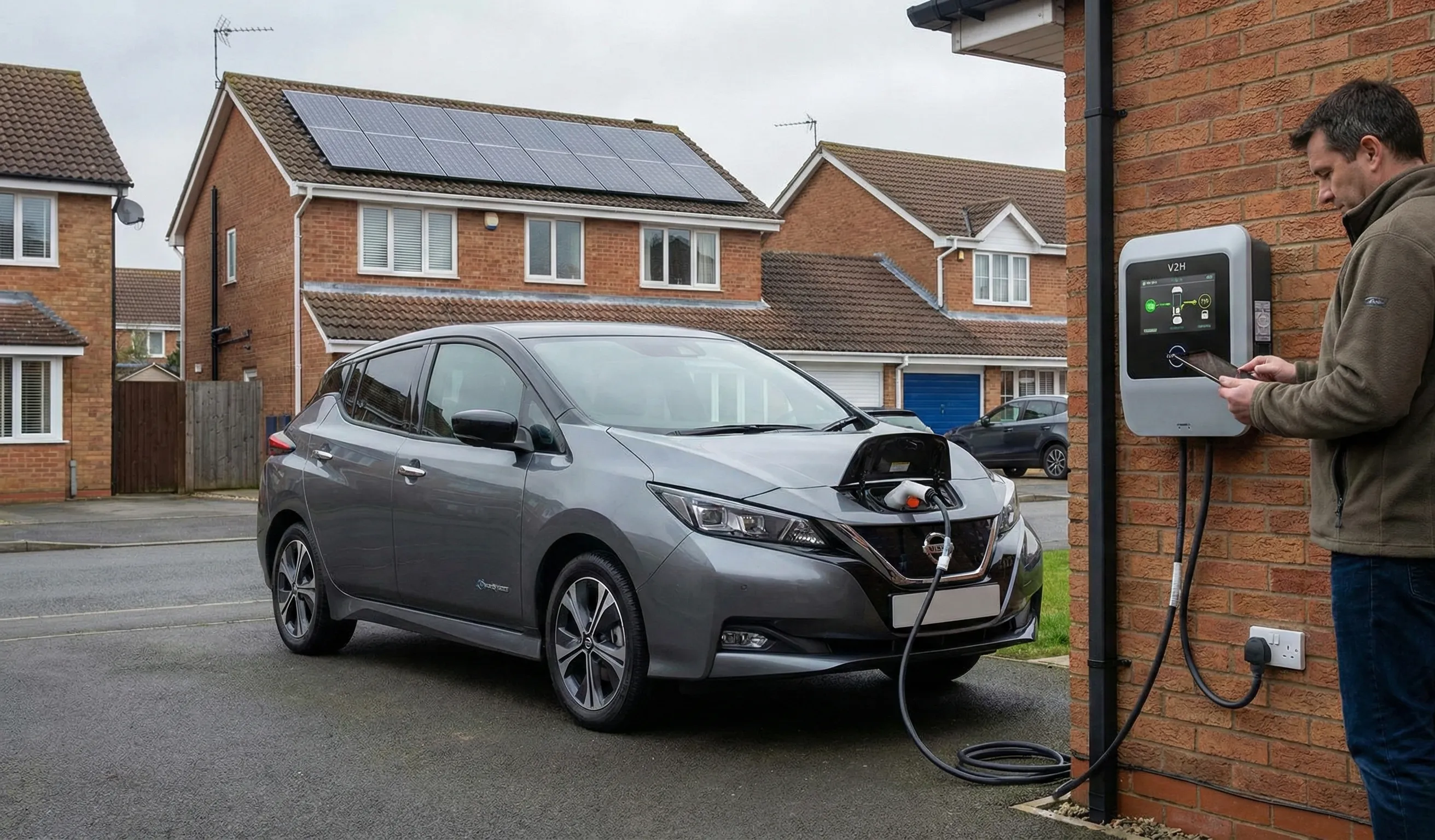
Vehicle-to-home, known as V2H, allows an electric vehicle to supply electricity back to a home using the energy stored in its battery. Instead of acting only as a load that consumes power, the car becomes a controllable energy source. For homeowners, this means the EV battery can support household demand during peak pricing periods, power outages, or times when grid electricity is expensive.
V2H effectively turns a parked vehicle into a large, flexible home battery that is already paid for as part of the car.
How Energy Flows From Car to Home
V2H works through bidirectional charging, which allows electricity to move both into and out of the vehicle. When activated, energy stored in the EV battery is converted into usable household electricity and delivered directly to the home’s electrical system.
The process relies on:
- The EV battery storing direct current electricity
- A bidirectional charger and inverter converting that power to alternating current
- A protected connection that feeds energy safely into the home
When correctly installed, this happens automatically and without manual intervention.
V2H Compared With Smart Charging
Both smart charging and vehicle-to-home (V2H) improve how electric vehicles interact with the grid, but they serve very different purposes. The key difference is whether energy can flow back into the home.
| Feature | Smart Charging | Vehicle-to-Home (V2H) |
| Primary function | Controls when an EV charges | Allows an EV to supply power to the home |
| Direction of energy flow | Grid → Vehicle only | Grid ↔ Vehicle ↔ Home |
| Reduces charging costs | Yes, by using off-peak tariffs | Yes, plus additional savings from self-use |
| Powers the home | No | Yes |
| Reduces evening grid reliance | No | Yes |
| Provides backup power during outages | No | Yes |
| Technology maturity in the UK | Widely available | Limited, early-stage |
Smart charging helps manage demand by shifting when electricity is drawn from the grid. V2H goes further by turning the vehicle into an active energy asset, capable of powering the home during peak periods or outages. However, it does not replace the need for seasonal energy storage for UK homes.
Why Bidirectional Charging Makes V2H Possible
Bidirectional charging is the foundation of V2H. Without it, electricity can only flow one way, from the grid into the vehicle. With it, the EV becomes part of the home energy system rather than a separate device.
This capability allows homeowners to:
- Use EV energy during high tariff periods
- Support household loads during outages
- Integrate vehicles into solar and battery strategies
As bidirectional technology expands, V2H is expected to play a growing role in how UK homes manage energy.
What You Actually Need To Power Your Home With An EV
Using an electric vehicle to power your home is possible, but it is not plug-and-play. V2H only works when the car, charger, and home are designed to operate as one system. Understanding what is genuinely required helps homeowners avoid false assumptions and costly mistakes.
A Bidirectional EV That Can Export Power
The starting point is the vehicle itself. Only EVs built with bidirectional capability can send electricity back out of the battery. Most electric cars on UK roads today cannot do this, regardless of battery size.
Models with confirmed or emerging V2H support include:
- Nissan Leaf
- Hyundai IONIQ 5
- Ford F-150 Lightning
Without a bidirectional EV, vehicle-to-home simply is not possible.
A Dedicated Bidirectional Charger
A standard EV charger can only pull electricity from the grid. V2H requires a bidirectional charger that can safely reverse the flow of energy from the car into the home.
This charger must:
- Support bidirectional power flow
- Be certified for V2H operation
- Integrate with home protection and control systems
Using the wrong charger makes V2H impossible, regardless of vehicle capability.
Home Electrical Infrastructure That Can Accept Exported Power
Most homes are designed to consume electricity, not receive it from a vehicle battery. V2H often requires changes to ensure power can be supplied safely and selectively.
This may include:
- Consumer unit upgrades
- Isolation and protection equipment
- Load management to prevent overload
A professional assessment is important before installation.
Professional Installation and System Integration
V2H is not a standard EV charger install. It involves coordination between the vehicle, charger, home electrics, and sometimes solar or battery systems.
Installers must understand:
- Bidirectional charging standards
- Grid compliance and safety requirements
- How to prioritise household loads
Without specialist expertise, systems either underperform or fail to meet safety regulations.
How Much Of Your Home Could An EV Power?
An electric vehicle battery can act as a temporary power source for your home, but its role is best understood as essential-load backup, not full household replacement. With the right vehicle and bidirectional setup, an EV can keep key systems running during outages or high-cost periods rather than powering everything at once.
The usable impact depends less on headline battery size and more on which circuits are supported and how energy is managed.
Essential Loads vs Whole-Home Backup
Most vehicle-to-home setups are designed to supply selected circuits, not every appliance. In practical terms, an EV battery can typically support:
- Refrigeration and food preservation
- Lighting and basic plug sockets
- Heating controls and circulation pumps
- Internet routers, phones, and laptops
High-demand loads such as electric ovens, immersion heaters, tumble dryers, or whole-home electric heating usually exceed what an EV system can supply continuously.
How Long an EV Could Supply Power
Runtime depends on battery capacity, usable discharge limits, and household demand. For a typical EV with a 60 to 75 kWh battery, realistic expectations could look like this:
| Load profile | Typical duration |
| Essential low-power circuits | 24 to 72 hours |
| Moderate household usage | 12 to 24 hours |
| High-demand appliances | Several hours |
Note: These ranges assume controlled use of selected circuits rather than normal day-to-day consumption.
Why Usage Habits Matter More Than Battery Size
Energy discipline matters more than raw capacity. Isolating non-essential loads, avoiding high-draw appliances, and prioritising critical systems can extend backup duration significantly. In practice, a well-managed EV battery often delivers more useful resilience than a larger battery supplying uncontrolled loads.
Used correctly, an EV becomes a flexible short-term energy buffer rather than a full replacement for the grid or a dedicated home battery system.
Is V2H Available In The UK Today?
Vehicle-to-home charging is possible in the UK, but it is not yet a mainstream option for most households. Right now, V2H sits in the early adoption phase, with limited vehicle support, specialist hardware, and small-scale deployments rather than wide consumer rollout.
Current Availability and Pilot Projects
The Nissan Leaf remains the most established example of V2H capability in the UK, largely due to its CHAdeMO charging standard. Several controlled trials are already underway to test how EVs can support homes and the wider grid:
- Energy suppliers and network operators are running V2H and V2G pilot schemes
- Trials focus on grid resilience, peak demand reduction, and home backup use
- Access is typically limited to specific regions, vehicles, and approved installers
These programmes prove that the technology works, but they are not yet designed for mass residential adoption.
Why Adoption Is Still Limited
V2H has not scaled quickly because it sits at the intersection of vehicles, homes, and the electricity grid. Several barriers still slow progress:
- Most new EVs use Combined Charging System (CCS) charging, which only recently began supporting bidirectional power
- Bidirectional chargers remain expensive and scarce
- Home electrical upgrades and grid approval add complexity
- Regulations and standards are still evolving
As a result, V2H remains a specialist solution rather than a plug-and-play upgrade.
What Is Likely to Change Next
Momentum is building. Over the next few years, V2H is expected to expand as:
- More EV manufacturers enable bidirectional charging as standard
- CCS bidirectional chargers become commercially available
- Grid operators create clearer frameworks for home export and backup use
- V2H integrates more closely with solar, batteries, and smart energy systems
V2H is not a widespread reality yet, but the foundations are being laid. For UK homeowners planning long-term electrification, it is moving from experimental concept toward practical option rather than remaining a niche technology.
Stay Connected with Upvolt
Get the latest updates on energy innovations, smart solutions, and exclusive offers.
EV vs Home Battery: Do You Still Need Both?
Electric vehicles have introduced a new kind of energy storage into UK homes, but they do not automatically replace the need for a dedicated home battery. The two serve different roles, and the right choice depends on how reliable, flexible, and available you need that storage to be.
Where an EV Can Replace a Home Battery
An electric vehicle with bidirectional charging can act as a powerful energy store when it is parked at home. In the right setup, an EV can cover many of the same functions as a stationary battery:
- Store low-cost electricity from off-peak tariffs
- Absorb excess solar generation during the day
- Provide backup power for essential circuits during outages
- Export energy during peak demand periods in supported schemes
In homes where the car is regularly parked overnight and during the day, an EV can deliver significant storage capacity without buying a separate battery.
Where a Dedicated Home Battery Still Wins
A home battery remains connected and available at all times. That consistency matters. Unlike an EV, it does not leave the house, does not depend on driving schedules, and responds instantly to household demand.
Home batteries are better suited to:
- Automatic solar self-consumption optimisation
- Evening peak-time electricity reduction
- Seamless backup without user intervention
- Integration with home energy management systems
For households that rely on predictable, always-on storage, a dedicated battery still offers stronger day-to-day control.
Why Some Homes Will End Up Using Both
EVs and home batteries solve different problems. One is mobile and high-capacity, the other is fixed and responsive. In homes with solar, this combination creates a layered system:
- Solar generation feeds the house first
- Excess energy fills the home battery
- Remaining surplus charges the EV
This setup maximises self-consumption, increases resilience, and reduces grid reliance more consistently than either option alone.
Should You Choose an EV Charger That Supports Future V2H?
EV charging hardware lasts many years, while vehicle capabilities are evolving rapidly. Choosing a charger that can support future bidirectional use can avoid expensive upgrades later.
Why Future-Ready Hardware Matters
A charger designed with bidirectional capability in mind protects flexibility rather than locking your home into a single use case:
- Supports future vehicle-to-home or vehicle-to-grid functions
- Reduces the risk of early obsolescence
- Aligns with smart tariffs and energy management platforms
- Keeps upgrade options open as standards mature
Even if V2H is not used immediately, compatible infrastructure avoids retrofit costs later.
Avoiding Costly Charger Replacements
Replacing a charger often means more than swapping hardware. Electrical work, certification, and configuration can quickly add up. Selecting a charger with upgradeable firmware and bidirectional readiness reduces the likelihood of repeating that process.
Key Questions to Ask Installers
Before committing to an EV charger, homeowners should ask:
- Does this charger support bidirectional charging, now or via upgrade?
- Is the hardware compatible with future V2H standards?
- Can firmware be updated without replacing the unit?
- Will this charger integrate with home energy systems later?
The right charger choice is less about today’s features and more about preserving flexibility as home energy systems become smarter and more interconnected.
The Smart Approach: Prepare Your Home Without Waiting
Waiting for EV technology to fully mature often means missing years of savings and flexibility. The smarter move is to prepare your home so it can adapt as new capabilities arrive, without needing costly rewiring or replacements later.
Install Infrastructure That Allows Growth
Future-ready homes focus on capacity and compatibility rather than specific features. A well-planned electrical setup makes later upgrades straightforward rather than disruptive.
Key steps include:
- Allowing spare capacity in the consumer unit for additional circuits
- Installing conduit and cabling routes for future EV charging or upgrades
- Choosing smart charging hardware with firmware upgrade capability
These decisions cost little when made early and avoid expensive retrofit work later.
Pair Solar With Flexible Energy Systems
Solar works best when it feeds more than just today’s demand. A flexible setup allows solar generation to support household use, vehicle charging, and future storage options without redesign.
A forward-looking energy strategy typically delivers:
- Lower grid dependence and more predictable bills
- Better use of daytime solar generation
- Strong foundations for EV charging, batteries, or backup power
Solar panels become far more valuable when they connect to energy systems designed to adapt as household needs and technology evolve.
Work With Installers Who Plan Beyond Today
The installer matters as much as the equipment. Forward-thinking professionals design systems around where home energy is heading, not just what is common now.
Look for installers who:
- Understand bidirectional charging and future standards
- Design layouts that allow expansion without replacement
- Explain how today’s choices affect tomorrow’s options
Preparation is not about guessing the future. It is about avoiding decisions that limit it. Homes built with flexibility in mind stay cheaper to run, easier to upgrade, and better positioned for the next wave of EV and energy technology.
How Upvolt Helps Homeowners Prepare For EV-Powered Homes
Using an electric vehicle as part of your home energy system requires more than just buying the right car. It depends on how well your charging, solar, and electrical infrastructure work together. Upvolt helps homeowners prepare for EV-powered homes by designing systems that are ready for bidirectional charging, flexible energy use, and future upgrades.
EV Chargers Built For What Comes Next
Upvolt specifies EV chargers with long-term compatibility in mind. Rather than installing hardware that only meets today’s needs, we focus on systems that can adapt as vehicle-to-home technology becomes more widely available.
Our approach supports:
- Chargers selected for bidirectional and V2H readiness
- Installations designed to avoid costly replacements later
- Integration with wider home energy systems rather than standalone charging
This ensures your EV charger remains an asset as technology and standards evolve.
Solar Panels And Battery Storage That Work Together
EV-powered homes perform best when solar generation, storage, and charging operate as one system. Upvolt designs setups where solar panels feed household demand first, then support EV charging or battery storage based on availability and cost.
This coordination helps:
- Increase on-site use of solar electricity
- Reduce reliance on peak-price grid power
- Prepare the home for backup or load-shifting scenarios
The result is a more resilient and predictable energy setup.
Skygate® Monitoring That Turns Energy Into Insight
Skygate® provides clear visibility into how energy flows between your home, solar panels, battery storage, and EV charging. Rather than static data, it shows how decisions affect costs and self-consumption in real time.
Homeowners gain:
- A clear view of EV charging impact on household energy use
- Insight into when solar or stored energy is being used most effectively
- Better information for future upgrades or tariff changes
This removes guesswork and supports smarter long-term decisions.
Practical Guidance For Future-Ready System Design
Upvolt works with homeowners who want systems that perform today and remain relevant tomorrow. Advice is based on real operating conditions, emerging EV technology, and how energy costs are changing.
Each system is designed to:
- Support future vehicle-to-home capability
- Avoid overbuilding or locking into closed platforms
- Remain flexible for batteries, smart tariffs, and evolving EV standards
This approach helps homeowners prepare for EV-powered living without waiting for technology to fully mature or risking expensive retrofits later.
Let’s Recap
Vehicle-to-home technology has the potential to reshape how UK households use energy, but it is not a plug-and-play solution today. While EV batteries offer large storage capacity, real-world use depends on bidirectional charging, compatible vehicles, specialist hardware, and homes designed to accept exported power safely.
For most homeowners, the smartest approach is preparation rather than immediate deployment. Installing flexible EV charging, designing solar and battery systems that work together, and avoiding infrastructure choices that limit future upgrades all place a home in a strong position as V2H becomes more widely supported.
V2H is moving from experimental to practical, but value comes from planning ahead, not assuming today’s EV can already do everything tomorrow’s technology promises.
About Upvolt
Upvolt helps UK homeowners design future-ready home energy systems that adapt as electric vehicles, solar panels, and energy technology evolve. Rather than focusing on single products, Upvolt takes a system-first approach that considers solar panelling, EV charging, energy storage, household demand, and future technologies as one connected system that evolves over time.
At the centre of every setup is Skygate®, Upvolt’s intelligent energy monitoring and control platform, which provides clear insight into how energy flows through the home and supports smarter decisions as needs change.
If you’re looking for a future-aligned renewable energy solutions specialist, complete our form today to start a conversation with our engineering team!
FAQ
What is Vehicle-to-Home (V2H) technology?
Vehicle-to-home (V2H) technology allows an electric vehicle to supply electricity back to a home using energy stored in its battery. Instead of only charging from the grid, the vehicle becomes a controllable energy source that can support household demand during outages or high-cost periods.
Can any electric vehicle power a home?
No. Only electric vehicles that support bidirectional charging can power a home. Most EVs on UK roads today are designed for one-way charging only, meaning electricity can flow into the car but not back out to the property. A compatible vehicle, bidirectional charger, and suitable home electrical setup are all required.
How long can an EV power a home during an outage?
This depends on battery size, which circuits are supplied, and how energy is managed. In most cases, an EV can power essential loads such as lighting, refrigeration, heating controls, and communications for anywhere from 24 to 72 hours. Supplying high-demand appliances or whole-home loads significantly reduces this duration.
Is Vehicle-to-Home technology available in the UK right now?
V2H is still at an early stage in the UK. A small number of vehicles and pilot programmes support it, but it is not widely available to most homeowners. More manufacturers and charger providers are developing bidirectional solutions, so availability is expected to improve over the next few years.
How is V2H different from smart charging?
Smart charging controls when an EV charges to reduce costs or avoid peak tariffs, but electricity still flows only from the grid to the car. V2H allows energy to flow both ways, enabling the vehicle to power the home itself. Smart charging manages demand, while V2H actively supplies electricity.

Alex Lomax
CEO & Co-Founder
Share article


Share article