-
Now live! Generate even more savings with our Skygate system. Click here to learn more.

On this page
- What Does It Actually Cost to Run Air Conditioning in the UK?
- Why the UK's Solar Generation Curve Aligns with Cooling Demand
- How Many Solar Panels Do You Need to Run Air Conditioning?
- The Role of Battery Storage in a Solar AC System
- What Type of Air Conditioning Works Best with Solar?
- DNO Notification and System Size: What Changes Above 3.68kW
- How Skygate® Integrates Solar and Air Conditioning
- How Upvolt Designs Solar Systems for Cooling
- Let's Recap
- About Upvolt
- FAQ
Solar Photovoltaic
15 mins read
Solar for Air Conditioning: A Smarter Way to Stay Cool
22 May 2026Stay cool without the high costs. Discover how solar panels can power your air conditioning and slash your energy bills and carbon footprint.
Take the first step toward energy independence today.
get a quote
On this page
- What Does It Actually Cost to Run Air Conditioning in the UK?
- Why the UK's Solar Generation Curve Aligns with Cooling Demand
- How Many Solar Panels Do You Need to Run Air Conditioning?
- The Role of Battery Storage in a Solar AC System
- What Type of Air Conditioning Works Best with Solar?
- DNO Notification and System Size: What Changes Above 3.68kW
- How Skygate® Integrates Solar and Air Conditioning
- How Upvolt Designs Solar Systems for Cooling
- Let's Recap
- About Upvolt
- FAQ
Air conditioning running costs are rising sharply in the UK, and grid electricity prices show no sign of returning to pre-2021 levels. For homeowners who have installed or are considering air conditioning, solar panels offer a practical way to offset a meaningful share of those costs, particularly in summer, when solar generation and cooling demand peak at exactly the same time.
The degree of savings depends on system design, usage timing, and whether battery storage is included, and this article explains how those variables interact.

15 min read
On this page
- What Does It Actually Cost to Run Air Conditioning in the UK?
- Why the UK’s Solar Generation Curve Aligns with Cooling Demand
- How Many Solar Panels Do You Need to Run Air Conditioning?
- The Role of Battery Storage in a Solar AC System
- What Type of Air Conditioning Works Best with Solar?
- DNO Notification and System Size: What Changes Above 3.68kW
- How Skygate® Integrates Solar and Air Conditioning
- How Upvolt Designs Solar Systems for Cooling
- Let’s Recap
- About Upvolt
- FAQ
Key Takeaways
- A standard split air conditioning unit running four to six hours per day across a UK summer typically consumes 300 to 600kWh over the season, a demand that falls within the summer surplus of a well-sized south-facing solar system generating roughly 45% of its annual output between May and August.
- Battery storage paired with a solar air conditioning setup extends the window of solar-powered cooling into the early evening, when generation has dropped but the AC unit may still be running.
- A standard grid-tied solar system shuts down automatically during a power cut due to anti-islanding protection, meaning air conditioning will stop working during an outage regardless of available sunlight.
- Any engineer installing, servicing, or decommissioning a refrigerant-based split AC system in the UK must hold a City & Guilds 2079 (or equivalent) F-Gas handling certificate, regardless of whether the unit is paired with solar panels.
What Does It Actually Cost to Run Air Conditioning in the UK?
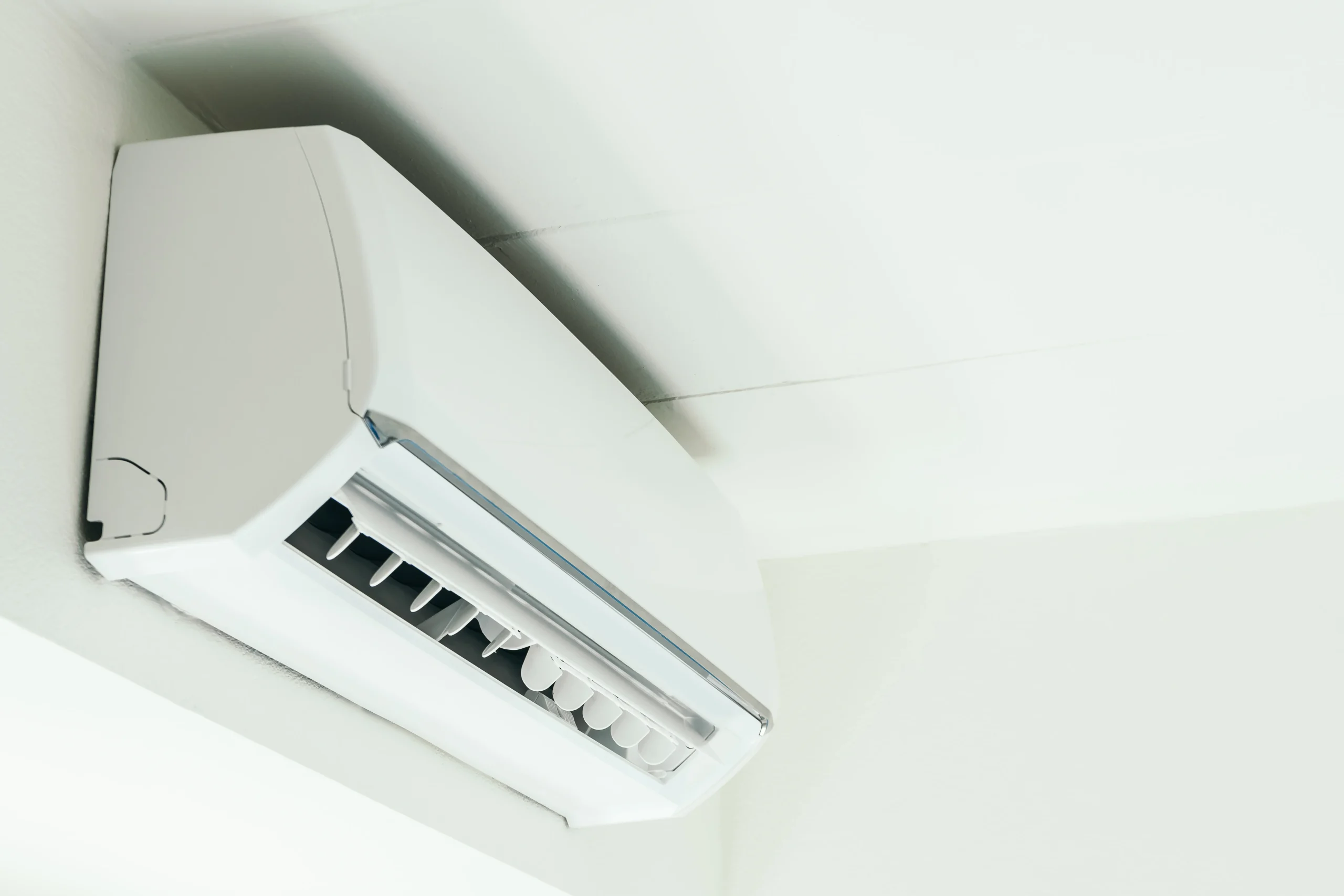
Running a standard AC unit typically costs between 14p and £1.68 per hour at current UK grid electricity rates, depending on unit type, size, and efficiency. The table below illustrates how that translates across the most common AC unit types, based on four hours of daily use across a 90-day summer season.
| AC Unit Type | Typical Power Draw | Estimated Cost Per Hour | Approximate Seasonal Cost |
| Split AC (wall-mounted) | 0.7 to 2.5kW | 17p – 60p | £60 – £215 |
| Portable AC | 1.0 to 2.5kW | 24p – 60p | £85 – £215 |
| Ducted AC (whole home) | 3.5 to 7.0kW | 84p – £1.68 | £300 – £605 |
Figures above are based on running costs for common AC unit types and assume the Ofgem price cap unit rate. Every unit of solar electricity consumed directly by your AC system avoids an import at that rate, which is where the financial value of solar-powered air conditioning is concentrated. The saving is highest when AC usage coincides with solar generation hours; if your unit runs primarily at night, the calculation changes considerably.
Why Running Costs Matter More Than Unit Purchase Price
A portable AC unit costing £300 at retail can cost more to run than it cost to buy within two to three summer seasons, once daily operation across a warm UK summer is factored in. This reframes the question from one about purchase price to one about operational cost, and operational cost is precisely the problem that solar addresses.
Why the UK’s Solar Generation Curve Aligns with Cooling Demand
UK solar generation peaks between May and August, exactly the months when residential cooling demand is at its highest, creating a near-perfect seasonal match between supply and demand. UK summers are becoming hotter and more variable according to the Met Office, strengthening the case for pairing solar with cooling year on year.
| Season | Solar Generation Level | AC Demand Level | Alignment Quality |
| Winter (Dec, Feb) | Low | Negligible | Poor |
| Spring (Mar, Apr) | Moderate | Low | Moderate |
| Summer (May, Aug) | High | High | Excellent |
| Autumn (Sep, Nov) | Moderate, Low | Low | Moderate |
A 4kWp south-facing system generates roughly 45% of its annual output across the May–August window, per industry evidence. Here’s what that means financially:
- Electricity that would otherwise be exported via the Smart Export Guarantee (SEG), the rate your energy supplier pays for unused electricity sent back to the grid, typically earns 5 to 15p/kWh.
- Used directly by the AC system instead, that same electricity saves 24 to 28p/kWh at current import rates.
- Self-consumption is always where the financial value is concentrated; SEG income is real, but modest by comparison.
Worth knowing, though: on overcast summer days, solar output drops significantly, and the AC unit will draw supplementary power from the grid. Cloudy spells aren’t uncommon in the UK, so solar-powered air conditioning isn’t a complete solution in every condition. The seasonal alignment is strong, but it’s not universal.
How Many Solar Panels Do You Need to Run Air Conditioning?
Worked Example: A 3-bed home in southern England runs a 2.5kW split AC unit for four hours per day.
- Daily consumption for the AC unit alone: 10kWh
- A 400W photovoltaic panel generates roughly 1.3 to 1.6kWh on a good summer day
- Covering that 10kWh demand would need approximately six to eight panels dedicated to the load, assuming no competing daytime appliances and a south-facing roof
This is a simplified illustration. Real solar panel sizing depends on a few things:
- Roof orientation
- Shading from neighbouring buildings or trees
- System losses through the inverter
- How much other appliances (washing machines, dishwashers, EV chargers) compete for solar output during peak generation hours
If multiple appliances run simultaneously, the AC unit draws less from the panels and more from the grid, the worked example above assumes AC is the primary daytime load.
Multi-room or multi-split configurations, running two or three indoor units at once, increase the panel count required substantially. A system powering two 2.0kW indoor units in parallel would need close to double the panels of the single-unit example above. An installer can model your actual load profile against the roof’s generation potential to give you a reliable figure before committing to a system design.
Our page on solar panels for your home covers the full residential specification and sizing process.
What About Running AC Overnight or on Cloudy Days?
Solar output is negligible after sunset and significantly reduced on overcast days. Air conditioning running during these periods draws from either a battery (if installed) or the grid. This is not a failure of the technology, it is a design consideration.
A home that relies on cooling for medical or comfort reasons overnight should factor battery storage or grid backup into the specification from the start, rather than treating it as an optional addition later.
The Role of Battery Storage in a Solar AC System
A battery storage system extends the window during which solar-generated electricity can power AC beyond daylight hours. A typical residential battery with 5 to 10kWh of usable capacity can extend evening cooling by two to four hours, depending on the AC unit’s draw and ambient temperature, in practical terms, running a 1.5kW split unit into the early evening on stored solar electricity rather than paying grid rates.
Battery storage makes the strongest case for:
- Households that use AC most heavily in the evening
- Families wanting to reduce overnight grid reliance
- Homes on time-of-use tariffs, where evening electricity is significantly more expensive than midday
For these households, a well-specified battery means the solar energy generated at noon is the energy cooling the house at 9pm.
If your cooling demand is concentrated in the middle of the day and solar generation already covers most of it, adding a battery purely for AC purposes may extend payback without proportional benefit. A system assessment is the reliable way to determine whether your evening load profile justifies the extra investment. Our guide to how to size your battery storage system sets out how capacity is matched to household demand.
What Type of Air Conditioning Works Best with Solar?
For solar-paired installations, an inverter air conditioner (a variable-speed or inverter-driven split system) is the most compatible choice. Unlike a fixed-speed unit that cycles on and off at full power, an inverter unit modulates its draw to match actual cooling demand, making better use of variable solar output rather than needing a fixed wattage that generation may not consistently deliver.
A modern air source heat pump with cooling capability is worth considering for a first installation, since these units provide both heating and cooling from a single system, changing the investment calculus considerably: a system earning its return across 12 months is a materially stronger case than one used only in summer.
Cooling efficiency here is typically expressed as a SEER (Seasonal Energy Efficiency Ratio) rating, a standardised measure of cooling output per unit of electricity, where higher ratings mean lower running costs for the same cooling delivered.
Portable and window units are less efficient and harder to size for solar coverage, their draw is less predictable and they’re not practical for a permanent solar-integrated setup. A fixed split or heat pump system, designed as part of the overall solar system from the outset, is the better long-term approach.
F-Gas Certification: What the Installer Must Hold
Split AC and heat pump systems use refrigerants classified as hydrofluorocarbons under the F-Gas Regulation requirements. Installation, servicing, and decommissioning must be carried out by an engineer holding a City & Guilds 2079 certificate or equivalent qualification. The Environment Agency enforces this requirement in England.
A homeowner who commissions a split AC installation from a company that cannot evidence this certification faces the risk of an illegal refrigerant installation and potential voiding of the manufacturer warranty. Solar installation is a separate certification matter covered by Microgeneration Certification Scheme (MCS) accreditation; a combined solar-plus-AC installation typically involves two distinct sets of qualifications, and both should be confirmed before any contract is signed.
Stay Connected with Upvolt
Get the latest updates on energy innovations, smart solutions, and exclusive offers.
DNO Notification and System Size: What Changes Above 3.68kW
Solar photovoltaic systems up to 3.68kW on a single-phase supply connect to the grid under a simplified notification process called G98, which the installer manages on your behalf. Above that threshold, things work a bit differently:
- Systems over 3.68kW require prior approval from the local Distribution Network Operator (DNO) under G99.
- This process can take up to 45 working days.
For most homeowners running a single split AC unit, this threshold is unlikely to be reached. But a household sizing a system to power multiple AC units across several rooms, combined with EV charging or a heat pump, may well specify a system that triggers G99.
This isn’t a barrier to installation, it’s a scheduling consideration: G99 approval should be factored into project timelines from the outset, so the installation date isn’t pushed back unexpectedly. A qualified installer handles the G99 application on your behalf.
How Skygate® Integrates Solar and Air Conditioning
A solar energy system without intelligent load control is passive, it generates electricity, and whatever happens to be switched on at that moment benefits. The Skygate® energy management system adds active optimisation: it can schedule high-demand appliances like AC units to run during peak solar generation windows, charge the battery during midday surplus, and shift cooling load away from expensive evening grid hours.
In practical terms for AC usage, Skygate® can pre-cool a room during the middle of the day when solar output is at its peak, storing the thermal benefit before generation drops in the late afternoon. That reduces the temperature load for the evening period, when the grid would otherwise be the only supply. This level of integration requires planning at the system design stage. It is not a retrofit that works with any AC unit out of the box.
How Upvolt Designs Solar Systems for Cooling
Getting the panel count right for a cooling application is different from sizing a standard solar system. AC demand is seasonal and more predictable in its timing than general household electricity use, which allows for tighter load modelling. When a homeowner asks about solar for air conditioning, the design process starts with three things: roof orientation and available panel area, the AC demand profile (unit type, estimated runtime, number of rooms), and whether battery storage or Skygate® integration suits their usage patterns.
Assessing Whether Solar AC Makes Sense for Your Home
A site assessment covers roof suitability, system size relative to AC load, whether the existing or planned AC unit is compatible with intelligent load management, and whether a battery adds sufficient evening coverage to justify the additional solar installation cost. In our experience, homes with south or southeast-facing roofs and daytime AC usage are consistently the strongest candidates; homes where cooling runs primarily at night need battery storage specified from the outset to make the numbers work.
Designing the Full System: Solar, Battery, and Skygate®
Upvolt combines panel sizing, battery specification, and Skygate® configuration into a single design that optimises for cooling demand specifically. The value of pairing heat pumps with solar becomes visible at this stage: the same system that manages summer cooling can manage winter heating, and the return on investment is spread across the full year rather than concentrated in four months.
All solar PV installation work is carried out by Upvolt’s MCS-certified operating companies, Upvolt Oxfordshire Ltd, OHM Energy Ltd, and Deege Ltd. MCS accreditation is the legal requirement for SEG eligibility and grid-compliant connection, not a differentiator.
Let’s Recap
Solar generation peaks in precisely the months when air conditioning demand is highest. A typical south-facing 4kWp system generates roughly 45% of its annual output between May and August, and every unit used to power AC directly avoids an import at current grid rates, worth significantly more than exporting the same unit via the SEG.
The saving depends on usage timing and system design. Daytime AC usage sees the strongest direct offset; evening or overnight cooling needs battery storage, properly sized against actual demand, to extend the usable solar window. A standard grid-tied system provides no power during an outage, only systems with island-mode inverters can run independently, so uninterrupted cooling for health or safety reasons needs that specified from the design stage.
Two regulatory requirements sit outside the solar work itself: F-Gas certification for the refrigerant-handling side of any AC or heat pump installation, and DNO notification under G99 for solar systems above 3.68kW. Neither is a barrier to a well-managed project, but both determine which installers are qualified and what the timeline looks like.
For most homeowners with south or southeast-facing roofs and daytime AC usage, solar-for-AC is financially sound, especially paired with an inverter-driven unit or a heat pump with cooling mode, plus battery storage if evening cooling is a consistent need.
About Upvolt
Upvolt is a renewable energy installer serving homeowners across southern England and the Home Counties. Upvolt installs solar panels, battery storage, heat pumps, EV chargers, and the Skygate® energy management system. Solar-for-AC installations benefit particularly from whole-system design that brings panels, battery, and Skygate® together, rather than treating cooling as a standalone load to be bolted onto an existing system.
All solar PV installation work is carried out by Upvolt’s MCS-certified operating companies, Upvolt Oxfordshire Ltd, OHM Energy Ltd, and Deege Ltd. MCS accreditation is the legal requirement that enables Smart Export Guarantee registration and ensures grid-compliant installation.
Cooling costs are only going one direction. If your roof and usage pattern make solar a strong financial case for running AC, get a free, no-obligation quote and Upvolt will show you the real numbers before you spend a penny.
FAQ
Can Solar Panels Run My Air Conditioning All Day, Even When It Is Cloudy?
Solar panels generate electricity whenever daylight is present, but output typically drops to 10 to 25% of peak capacity on overcast days. A standard split AC unit drawing 1 to 2.5kW will frequently draw supplementary power from the grid during cloudy spells. Battery storage can bridge short overcast periods if the battery was charged during earlier sunny windows, but prolonged cloud cover means the grid covers the shortfall. The technology works well across a UK summer overall; mixed weather is a design variable, not a reason to discount the approach.
Will My Solar Panels Still Power the Air Conditioning During a Power Cut?
A standard grid-tied solar system shuts down automatically during a power cut. This is a safety mechanism called anti-islanding protection, which prevents electricity flowing back into the grid while engineers work to restore supply. During an outage, air conditioning and all other appliances stop, regardless of how much sunlight is available. A system with an island-mode or off-grid capable inverter can continue operating independently, but this must be specified at the design stage. If uninterrupted cooling is a health or safety requirement, that capability needs to be part of the initial specification conversation.
Do I Need Any Special Solar Equipment to Power Air Conditioning?
A standard grid-tied solar PV system powers air conditioning in the same way it powers any other electrical appliance, with no specialist solar equipment required purely because the load is an AC unit. However, optimising for cooling specifically, scheduling runtime during peak generation, extending operation into the evening via battery, and integrating with Skygate®, requires the system to be designed with that goal in mind from the outset. Retrofitting intelligent load control after installation is significantly more complex and not always possible with every AC unit.
Does the Person Installing My Air Conditioning Need Any Special Certification?
Yes. An engineer installing, servicing, or decommissioning a split AC or heat pump system containing refrigerant must hold a City & Guilds 2079 certificate under the retained UK F-Gas Regulation. This applies regardless of whether the unit is paired with solar. The solar PV installation is covered separately by MCS accreditation, which is the legal prerequisite for Smart Export Guarantee eligibility. A combined solar-plus-AC project involves two distinct sets of qualifications, and confirming both before signing a contract is a straightforward step that protects against an illegal installation and potential warranty issues.
Is Solar-Powered Air Conditioning Worth It If I Only Use the AC for a Few Weeks a Year?
If cooling is limited to occasional hot days across a handful of weeks, the financial case for sizing a solar system around AC demand is weak. The return on investment from solar is strongest when self-consumption is consistent across multiple loads and multiple seasons, not when it depends on a single seasonal appliance used intermittently. In that scenario, the better question is whether solar makes sense for your overall household electricity use, with cooling as an incidental summer benefit. If you run AC for several hours a day across a four-month season, the seasonal alignment between solar generation and cooling demand is strong enough to factor cooling load into the system sizing from the start.

Alex Lomax
CEO & Co-Founder
Share article


Share article